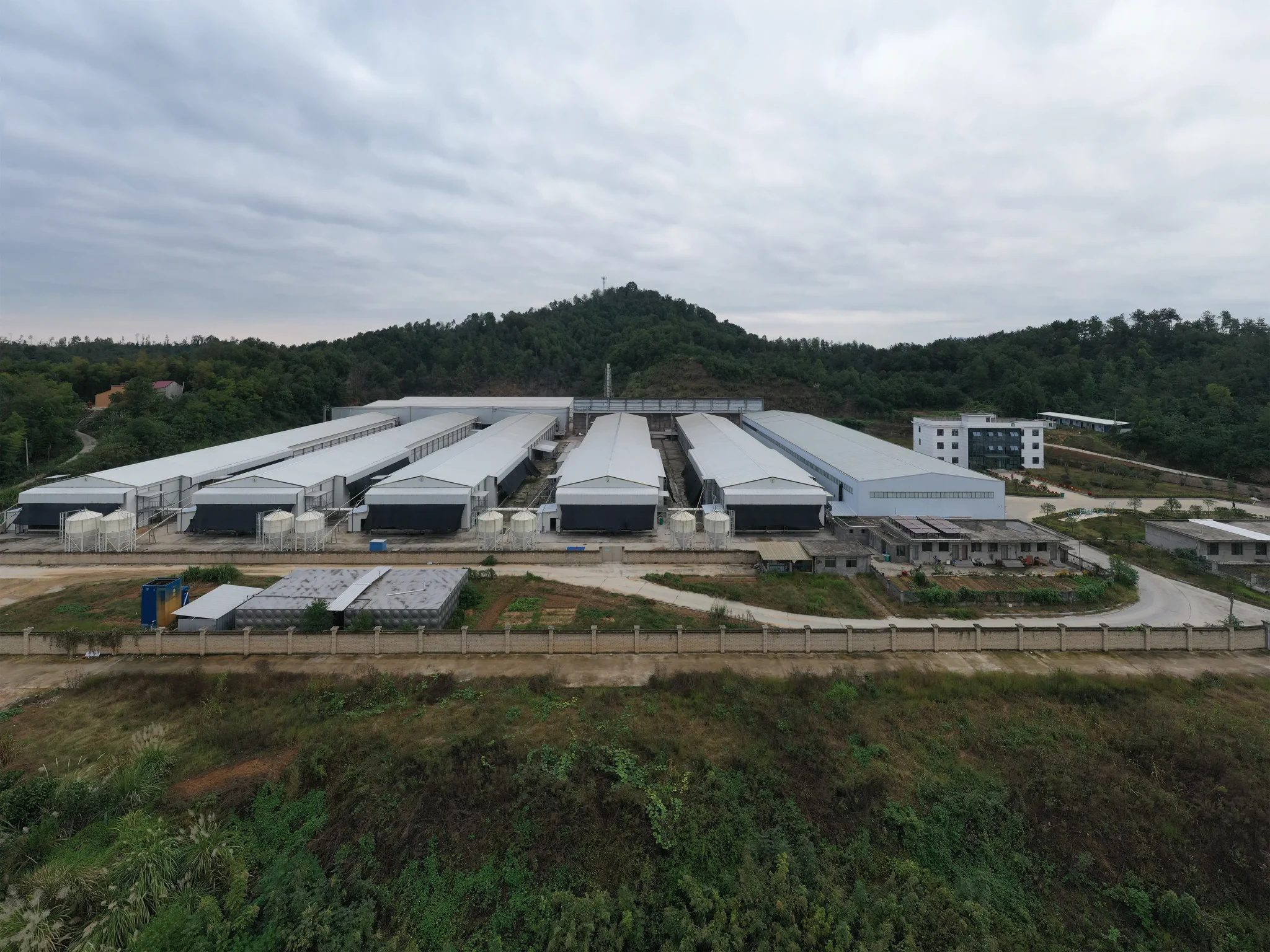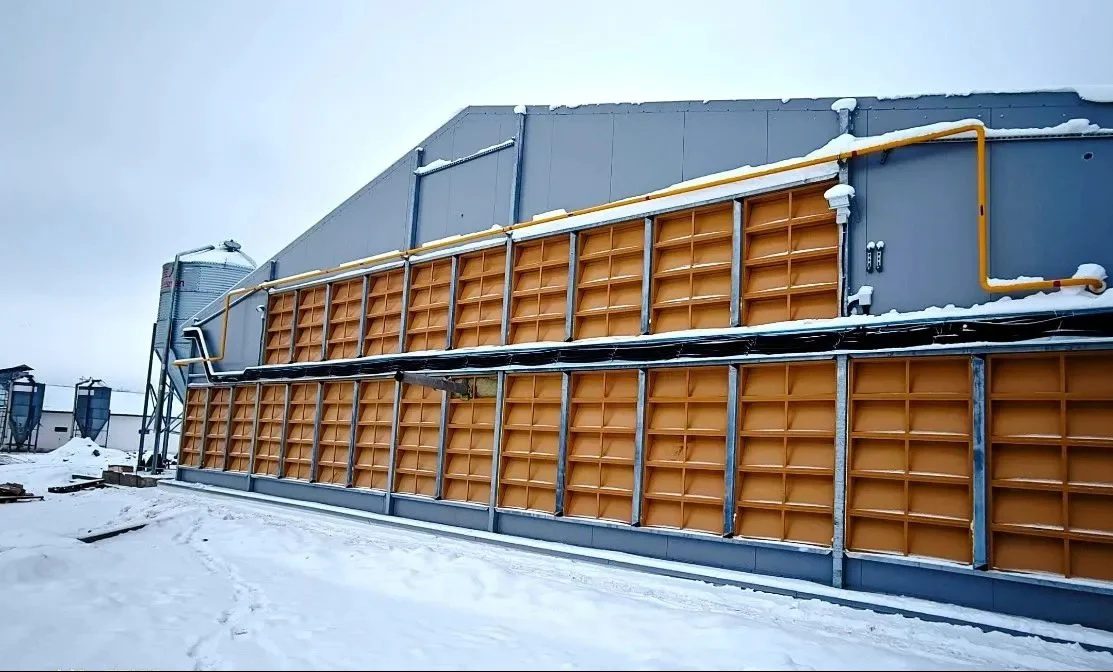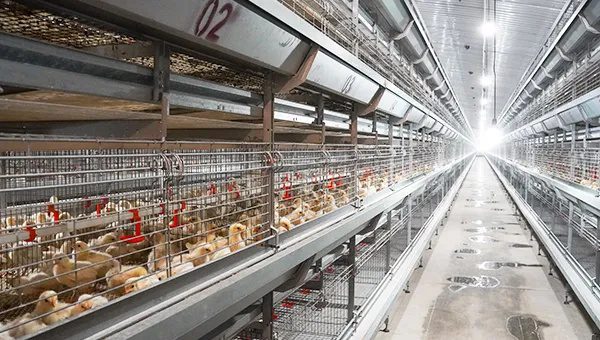
A layer cage system is the structural backbone of a commercial egg operation. The system holds the birds, automates feeding and watering, collects the eggs, and removes manure on a continuous cycle. The cage you choose determines stocking density, labor input, feed conversion, and how many saleable eggs you ship per day. This guide walks through design types, capacity planning, automation components, and supplier selection so you can size a system that fits your barn, your climate, and your production target.
What Is a Layer Cage System?
A layer cage system is an assembly of wire-mesh enclosures stacked in tiers inside a poultry house. Each enclosure houses a defined number of laying hens, typically four to eight birds depending on the cage design. Feed, water, eggs, and manure all move through the system on dedicated paths, which keeps labor input low and gives each bird a controlled environment.
Modern systems are not just cages. A complete installation includes the cage structure itself, automatic feeding lines, nipple drinking lines, egg collection belts, manure removal conveyors, and an environment control package sized to your barn. Each component is selected to fit the cage design and your production targets.
Layer Cage Design Types: A-Type vs H-Type
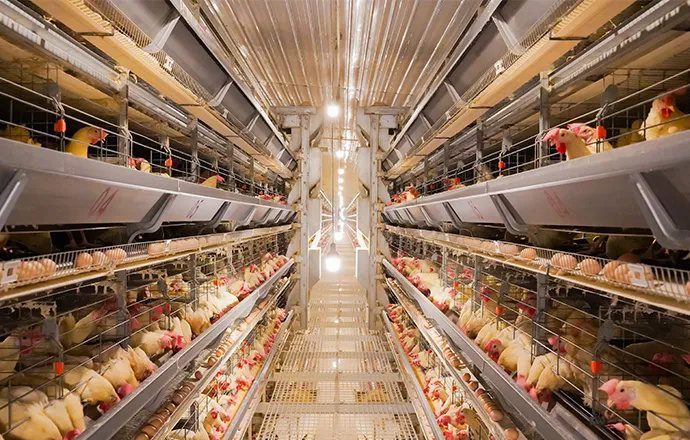
Two cage geometries dominate commercial egg production worldwide. They look similar at a glance, but they are designed for very different operating scales.
A-Type Layer Cage
The A-type layer cage has a stepped, pyramid-like profile with three or four tiers. Cells are typically 470 mm × 350 mm × 380 mm and house four birds per cell. The angled structure catches light evenly across all tiers, and the open silhouette makes A-type systems easier to inspect and ventilate than fully enclosed stacks.
A-type cages suit small to mid-scale operations. Installation is faster because each frame is bolted together rather than welded into a vertical column. Manure handling is usually manual or semi-automatic on A-type installations, since the angled tiers expose the dropping board. Per cell, you can run four to eight birds depending on body weight, with YMAKO’s standard at four birds per cell on 3-tier A-type.
H-Type Layer Cage
The H-type layer cage is a fully enclosed vertical stack that grows downward in tiers, often four to eight levels tall. Each cell is wider than an A-type cell, typically 600 mm × 600 mm, and holds eight birds per cell. The closed structure maximizes bird capacity per square meter of floor, which is the main reason commercial operations above 30,000 birds adopt H-type.
H-type cages require a fully automated manure removal belt under each tier. The closed geometry blocks natural light, so a controlled lighting program becomes mandatory. The vertical scale also makes H-type systems less forgiving of installation errors, which is why factory pre-assembly and on-site supervision matter more than they do for A-type.
Quick Comparison
| Feature | A-Type | H-Type |
|---|---|---|
| Tiers | 3-4 | 4-8 |
| Birds per cell | 4 (3-tier) / 4-8 (4-tier) | 8 |
| Cell size | 470 × 350 × 380 mm | 600 × 600 mm |
| Best scale | 5,000-30,000 birds | 30,000-200,000+ birds |
| Manure handling | Manual or semi-auto | Automatic belt under each tier |
| Lighting | Natural light acceptable | Fully controlled program required |
| Install complexity | Low | Medium to high |
If your flock is below 30,000 birds, A-type is almost always the right choice. Above 50,000 birds, H-type’s density advantage starts to outweigh the higher install cost.
How Many Birds Per Cell: Industry Standards
Bird density per cell is governed by body weight, ventilation capacity, and welfare regulation in your country. The figures below are the most common commercial baselines:
- A-type 3-tier: 4 birds per cell (small to mid commercial flocks)
- A-type 4-tier: 4-8 birds per cell (mid commercial)
- H-type 4-tier: 8 birds per cell (large commercial)
- H-type 8-tier: 8 birds per cell, with each vertical unit holding up to 128 birds (industrial scale)
YMAKO’s standard H-type cell holds 32 birds in the wider production configuration, which is a tighter configuration used where barn space is the binding constraint. For most buyers the 8-bird cell is the more conservative starting point. Cell density above the standard baseline raises egg output per square meter but increases mortality risk and pulls ventilation capacity.
Capacity Planning: 5,000 to 200,000 Birds
Capacity planning starts with three numbers: your annual egg demand, your barn floor area, and your target bird density. From those you derive the cage count, the barn length, and the equipment line capacity.
Small Commercial (5,000-10,000 Birds)
A single barn running A-type 3-tier cages covers this scale. Expect 1,500-2,000 birds per linear meter of cage line, depending on tier count. Egg collection is typically manual on a small A-type operation, although a basic belt conveyor pays for itself quickly above 5,000 birds.
Mid Commercial (10,000-30,000 Birds)
A-type 4-tier or H-type 4-tier systems both fit this scale. Automatic feeding and manure removal become economic at this size, since labor cost per dozen eggs drops sharply once a single operator can run the full barn. Egg collection moves to a belt with a manual or semi-automatic packing table at the end of the line.
Large Commercial (30,000-100,000 Birds)
H-type 4-tier is the standard for this scale. Egg collection becomes fully automatic, with inclined belts that carry eggs to a central packing room at 40,000-45,000 eggs per hour. Manure removal is automatic under every tier, with daily or twice-daily belt cycles. Climate control is a closed-loop PLC system with variable-speed fans and cooling pads sized to your location.
Industrial (100,000-200,000+ Birds)
H-type 8-tier in multi-barn configurations. Each barn typically holds 25,000-50,000 birds, with the system sharing a central egg grading room, feed mill, and manure processing plant. At this scale the cage system is one decision inside a much larger site plan, and most buyers lock in the cage supplier early so the barn civil work matches the cage layout.
Components of a Complete Layer Cage System
A cage is only the visible part. The systems that determine egg output, feed conversion, and labor cost are the components you put around the cage.
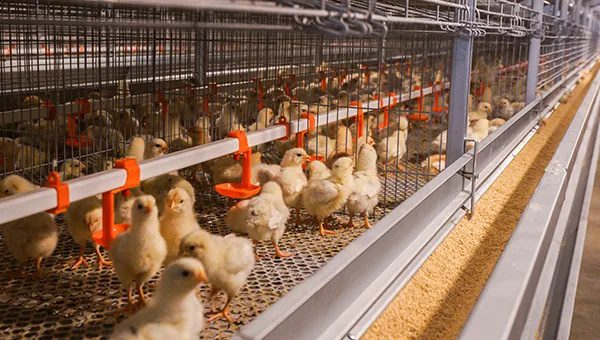
Cage Frame and Wire Mesh
YMAKO uses Q235 steel frames hot-dip galvanized with a 275 g/m² zinc coating, which is the same corrosion protection used across the commercial poultry equipment industry. The egg guard plate uses the same 275 g/m² galvanizing at 0.8 mm or thicker. Door wire is 5.0 mm or larger so the door does not deform under daily bird contact. Sliding doors give full-width access when you move birds in or out.
Feeding System
A chain feed conveyor with a 110 mm PVC or 110-140 mm hot-dip galvanized feed line is the industry baseline. Feed bins range from 1.6 tons for a small barn to 33.4 tons for an industrial site, in HDG, SS304 stainless, or FRP. Programmable controllers run two or three feed cycles per day, with volume adjusted for bird age and laying stage. The gear motor is typically 1.1 kW.
Drinking System
SS304 stainless steel nipple drinkers with 360-degree activation are the modern standard. The inlet is 50 mm PVC, the main pipe 22 × 22 mm or 25 mm, with a chemical medicator (D25 or D45 type) on the inlet line for vaccine delivery. A pulse water meter (DN25, SS304) tracks consumption. The drinker line height is winch-adjustable so it rises with the birds.
Egg Collection System
Nylon egg collection belts, 3.0 mm thick and 500 mm wide per line, run at 40,000-45,000 eggs per hour on large operations. The belt is inclined at 15-20° so eggs roll gently to a central collection point with no impact damage. Two collection cycles per day, morning and afternoon, keep belt loading low. A single operator handles the full barn.
Manure Removal System
Manure belts run under each tier. On H-type systems the belt is automatic with a scraper at the end of the barn. Frequency is daily on most commercial operations, twice daily in hot climates where manure dries fast. The manure drops into a cross conveyor or directly into a composting or drying line.
Climate Control
The control package is sized to your barn and your local climate, not pulled from a catalog. Exhaust fans are variable-speed, belt or direct drive. Cooling pads are cellulose with a recirculating pump. Heating uses gas brooders or hot water exchangers. Inlets are ceiling or sidewall, automatic or manual. The PLC controller ties the whole package to temperature, humidity, and ammonia setpoints.
Pullet Phase: Why the First 16-18 Weeks Matter
Birds move into the layer cage system after 16-18 weeks in a pullet cage, which is the rearing stage. Feed and water lines adjust upward as birds grow. Sliding doors make the transfer to layer cages simple. Dropping boards keep manure out of feed during the early weeks. Lighting simulates natural sunrise and sunset to reduce stress and support healthy development. Cup drinkers are used for day-old chicks because they cannot activate a nipple reliably.
The pullet phase determines laying performance for the rest of the flock. A pullet that enters the layer cage at the right body weight and the right lighting program will peak above 90% and hold a steady curve for 30+ weeks. A pullet that misses either target peaks lower and breaks earlier. Most production losses blamed on the layer cage actually start in pullet rearing.
Common Layer Cage Design Mistakes
A few mistakes show up on almost every project that underperforms.
- Undersized ventilation: a barn that holds 30,000 birds but only has fans for 20,000 birds will see mortality spike in summer. Match the climate control package to peak summer load, not average.
- Manual manure handling on H-type: the closed geometry of H-type makes manual cleaning uneconomic and unhygienic. If you commit to H-type, commit to the manure belt.
- Single-tier lighting: a barn where the bottom tier is in permanent shadow produces uneven laying curves. Every cage position needs the same lux level.
- Mixed-age flocks in the same barn: a 30-week flock and a 60-week flock should not share lighting or feed cycles. Either split the barn or stage bird placement by at least 10 weeks.
- No backup power: a power outage during a hot afternoon kills birds in minutes on a fully stocked barn. A generator sized for fans and drinker lines is non-optional above 10,000 birds.
How to Choose a Layer Cage Supplier
A cage system is a 15-20 year asset. Supplier selection matters as much as the design choice.
Check three things on any shortlist:
- Material certification: ask for the galvanizing certificate (275 g/m² is the standard), the wire diameter spec, and the steel grade. If a supplier cannot produce these documents, the cage is not what they quote.
- Installed reference list: ask for three farms at your target scale, ideally in a climate similar to yours. A supplier with reference farms in your region has solved the problems you will hit.
- Installation supervision: a layer cage system that arrives as a kit but is assembled by untrained labor is the most common cause of underperformance. Factory pre-assembly plus on-site supervisor for the first barn is the minimum you should accept above 10,000 birds.
YMAKO supplies layer cage systems to operations in 60+ countries, with reference farms ranging from 5,000-bird family operations to 200,000-bird industrial sites. A typical supply scope includes the cage structure, feeding, drinking, egg collection, manure removal, and climate control sized to your barn, with factory pre-assembly and on-site supervision available on request.
Frequently Asked Questions
How many birds fit in a layer cage system per square meter?
Density depends on cage type. A-type 3-tier systems typically run 12-16 birds per square meter of barn floor. H-type 4-tier systems run 24-32 birds per square meter. H-type 8-tier systems run 40-50 birds per square meter. The exact number depends on cell size, tier count, and barn layout.
What is the lifespan of a galvanized layer cage?
A Q235 steel cage with 275 g/m² hot-dip galvanizing lasts 15-20 years in normal commercial conditions. Lifespan drops sharply in barns with high ammonia, salt exposure, or chronic high humidity without adequate ventilation.
Can I expand an A-type system to H-type later?
You can expand the barn with H-type cages, but you cannot convert an installed A-type system to H-type. The frame geometry, manure handling, and lighting layout are different. Most operators who outgrow A-type add a second H-type barn rather than retrofit the first.
How much feed does a layer hen eat per day?
Feed intake depends on body weight, laying stage, and ambient temperature. A standard commercial layer eats between 100 g and 120 g per day during peak production, with intake rising in cold weather and falling in hot weather. Feed conversion runs between 2.0 kg and 2.3 kg of feed per kg of egg mass at peak efficiency.
Is a layer cage system better than floor housing?
For commercial-scale egg production, a cage system produces cleaner eggs, lower mortality, lower feed conversion, and lower labor cost than floor or free-range housing. Floor housing has a place in niche and premium markets, but at 10,000+ birds the cage system is the economic choice.
Plan Your Layer Cage System
A layer cage system is sized to your barn and your production target. If you are planning a new build or expanding an existing operation, the next step is a barn layout and equipment list matched to your local climate and your target flock size. YMAKO provides cage structure, feeding, drinking, egg collection, manure removal, and climate control as one integrated package, with reference designs available for 5,000 to 200,000 bird flocks.
For a deeper look at the planning side of this decision, read the layer cage system design and capacity guide and the poultry climate control sizing guide. Both cover the numbers behind the choices above in more detail.
If you want a custom layout and equipment list for your barn, share your barn dimensions, target flock size, and local climate, and YMAKO engineering will return a complete system proposal.