Poultry house design is the part of a new farm that is hardest to fix later. Get the orientation, eave height, and equipment layout right at the build stage, and the house runs for 20 years with minor changes. Get them wrong, and you are living with bad ventilation, low feed intake, or a manure system that backs up, for the life of the building.
This guide is built from the layout decisions we make on YMAKO projects across Asia, Africa, Latin America, and Eastern Europe. The numbers (eave heights, manure belt widths, drinker line sizes) are from our own equipment spec, because the building has to fit the cages and the cages have to fit the building. If you are starting from scratch, work through this before you talk to a builder.
The Three Decisions That Drive Everything Else
Most poultry house design questions come back to three numbers:
- Flock size. This sets house length, number of cage rows, and feed bin capacity.
- Climate. Open-sided house, closed house with tunnel ventilation, or fully environmentally controlled? The climate decides wall and roof design, fan count, and cooling pad area.
- Local code. Distance to property line, waste handling rules, and bird density limits vary by country and even by province. Check before you draw the foundation.
Once those are decided, the rest is dimensioning.
Orientation and Footprint
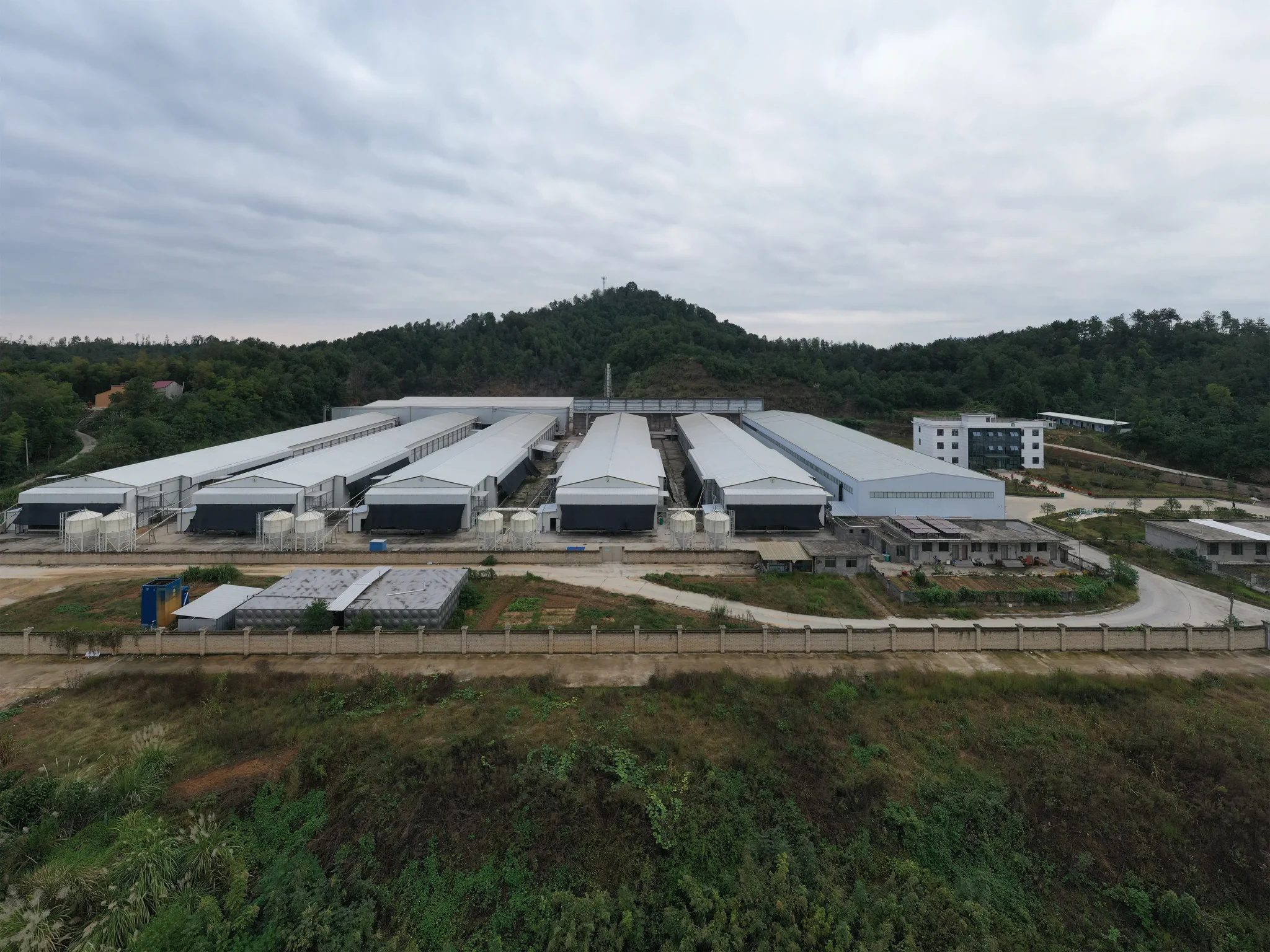
Long axis east-west. This is the rule for houses in the northern hemisphere south of 35° latitude, and the rule everywhere in the tropics. The long wall faces north-south, so the sidewall sun is limited to early morning and late afternoon. In a closed house, this measurably cuts the cooling load compared to a north-south long axis.
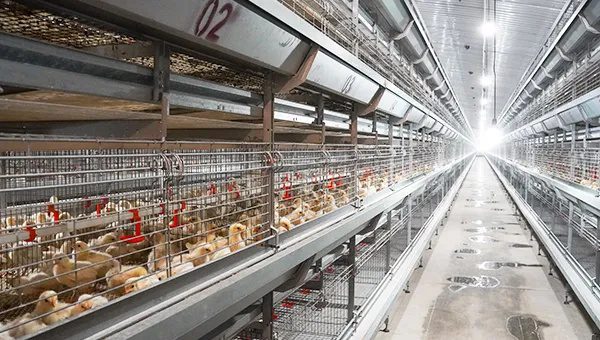
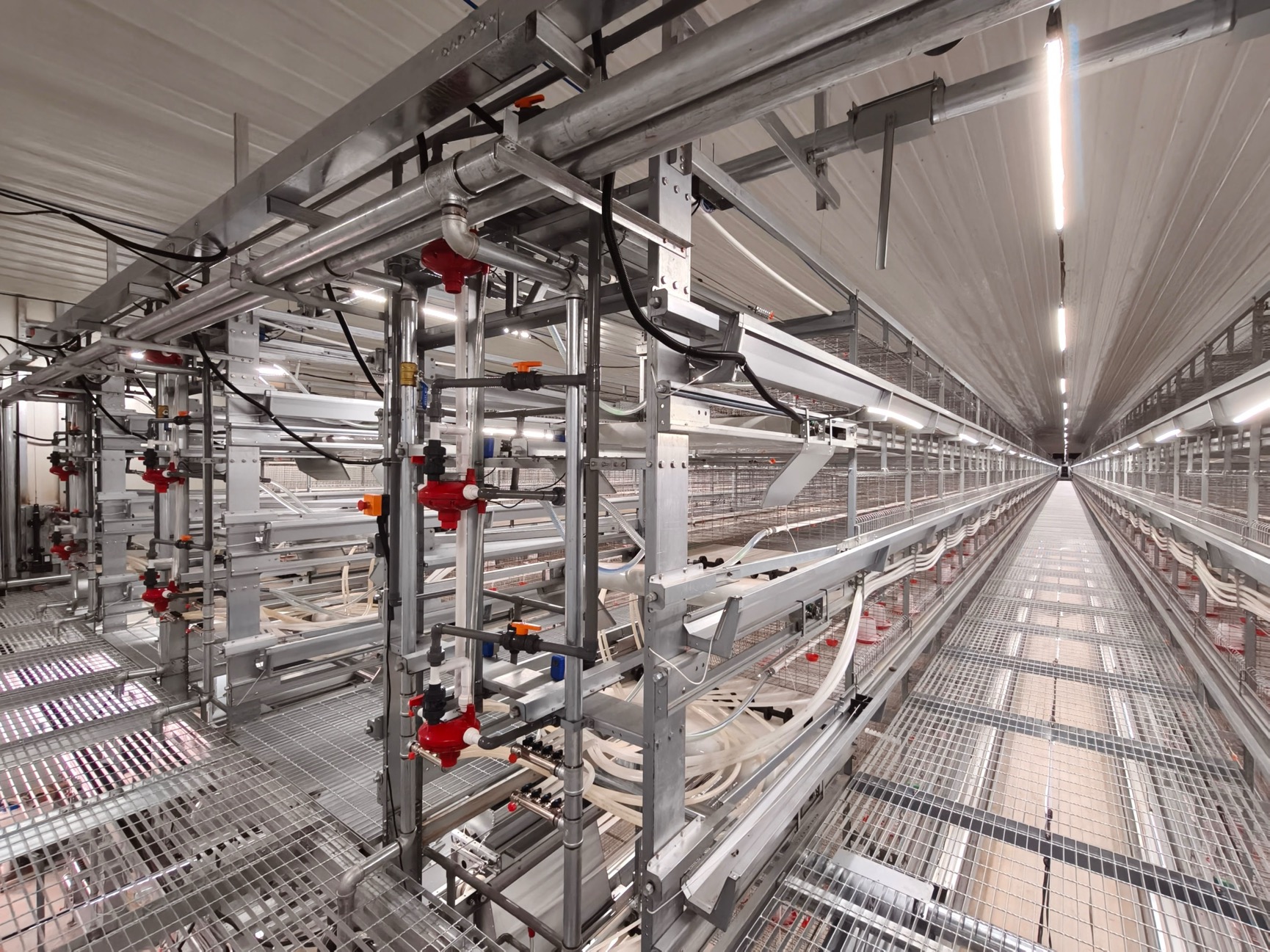
House length. Driven by the cage row length and the number of rows. A 4-tier H-type layer cage row is usually 90–100 m long. A typical 30,000-bird layer house has 3 rows, so the house is 95–100 m long.
House width. 12–15 m is the practical range. A 12 m wide house fits 3 cage rows with 1.8 m walkways. Wider than 15 m is harder to ventilate evenly, and you start to need extra support columns in the cage row.
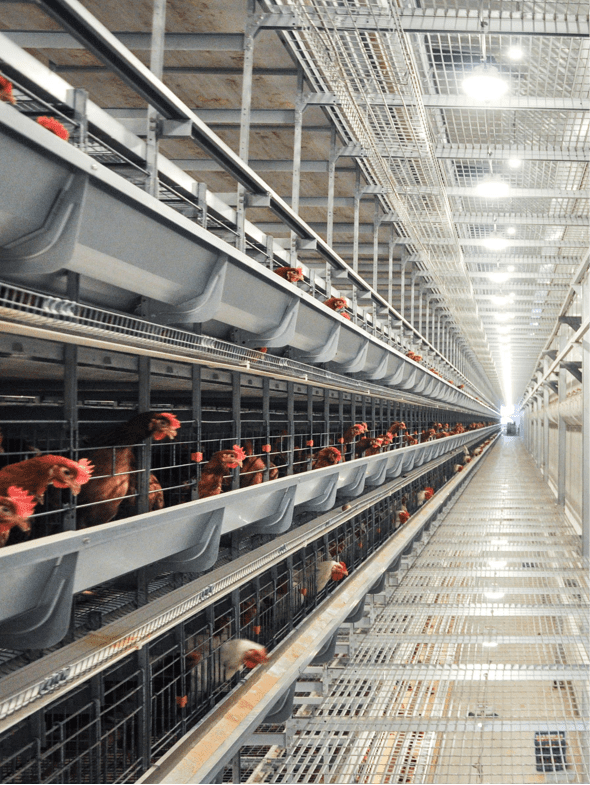
Eave height. This is the number that gets missed most often. The cage tier count drives it:
| Layer house | Eave height |
|---|---|
| 3-tier | ≥ 3.3 m |
| 4-tier | ≥ 4.0 m |
| 5-tier | ≥ 4.6 m |
| 6-tier | ≥ 5.5 m |
| 8-tier | ≥ 7.5 m |
| Broiler house | Eave height |
|---|---|
| 3-tier | ≥ 3.2 m |
| 4-tier | ≥ 3.8 m |
If the eave is too low, the top tier does not get enough air movement and birds in the upper cages run hot. We see this on retrofits where someone added a tier to an existing house. The fix is a bigger fan, not a bigger bird problem.
Climate and Ventilation
Three ventilation setups cover most projects:
Open-sided house (natural ventilation). Curtains or panels on both long walls, no fans. Works in climates where the daily high stays below 28°C for most of the year. Cheap to build, but production drops in heat waves because there is no air speed on the birds.
Closed house with tunnel ventilation. Fans at one end pull air through the house length-wise, with cooling pads at the inlet end. House is fully enclosed with insulated walls and ceiling. This is the standard for layer farms above 20,000 birds in hot climates. Design target: 2.5–3.0 m/s air speed at bird level in summer.
Environmentally controlled house. Tunnel ventilation plus in-floor or in-ceiling heating for cold climates. Used in Europe, North China, and parts of Central Asia. The full EC setup also includes automated in-house pressure control and CO₂ sensing.
A 30,000-bird closed layer house in a hot climate needs about 12–16 fans (1.4 m diameter) and 25–30 m² of cooling pad. The exact number depends on bird weight, target air speed, and local summer wet-bulb temperature.
Feeding, Drinking, and Manure Layout
A poultry house is really a machine that holds birds, feed, water, and manure in the right place at the right time. The equipment layout has to follow the building.
Feeding. A 110 mm PVC or 110–140 mm HDG feed line runs the length of each cage row, above the top tier. Feed drops to each tier through tubes. The feed bin sits outside the house, at one gable end, with the conveyor entering through the wall. For a 30,000-bird house, you need 1.1 kW gear motors on each line — one motor per row.
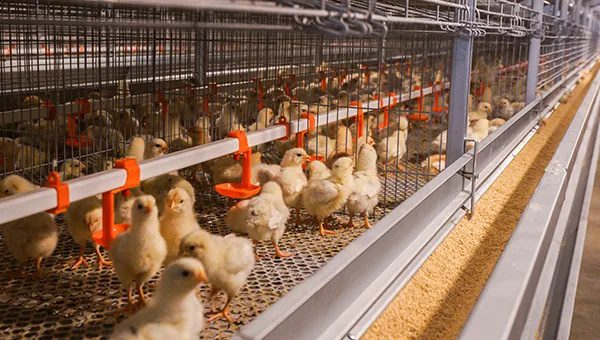
Drinking. A ⌀50 mm PVC main inlet enters the house and branches to ⌀25 mm or 22×22 mm square lines running the length of each cage row. Each cage has a SS304 nipple drinker with a drip tray underneath. A pressure booster pump on the inlet keeps the system above 1.5 bar at the far end. A French-made D25 or D45 chemical doser on the inlet line handles vaccine and vitamin delivery through the water.
Manure. A PP manure belt (1.0, 1.1, or 1.2 mm thick, depending on the load) runs under each tier, with a 1.5 kW drive motor. The belt exits the house through a sealed chute at one end and drops into a cross conveyor or a manure shed. The belt speed stays below 2.0 m/s, otherwise the manure scatters at the transfer.
Egg collection. A 500 mm wide nylon egg belt (3.0 mm thick) runs the length of each layer row, lifting eggs to the cross conveyor at the gable end. The climb angle is 15–20°. The full system runs at 40–45k eggs per hour on a W500 line.
These are the same numbers that drive the Poultry Control System spec. If you change the eave height, the line lengths change. If you change the row count, the feed bin and manure handling change.
Common Layout Mistakes
We see the same problems on most of the projects we review:
- Cross-conveyor pit in the wrong place. If the egg or manure cross conveyor exits at the long side of the house, it has to cross the walkway, which gets in the way of feeding and bird movement. Put it on the gable end.
- Inlet too small. A ⌀50 mm water main on a 100 m house drops below 1 bar at the far end. Step up to ⌀63 mm or add a pressure booster.
- No access for manure truck. The manure shed or compost area needs truck access on a concrete pad. If the truck has to back up over dirt, it becomes a mess in the rainy season.
- Single power feed. A house that loses power loses feed, water, ventilation, and egg collection at once. A backup generator on a transfer switch is not optional in a closed house.
Planning the Build
The build sequence that saves the most rework:
- Lock in the flock size and target production numbers. These set house length and tier count.
- Confirm the climate design. Open, closed, or EC. This sets wall, ceiling, and fan count.
- Pick the cage and equipment supplier first. The supplier’s spec drives the building dimensions, not the other way around. At YMAKO, we send the building footprint and the equipment spec in the same package.
- Confirm utility connections. Power (kVA), water (L/day), and feed delivery truck access.
- Foundation and floor. Concrete floor with a 1:60 slope toward the manure exit. Allow 150 mm for the manure pit below the belt.
The numbers in the body of this guide are sizing rules from YMAKO equipment spec, not project pricing. For an actual quote, share flock size, climate design, and target country with the YMAKO sales team.
FAQ
What is the standard eave height for a 4-tier layer house?
At least 4.0 m. Going to 4.5 m gives you headroom for service and reduces upper-tier heat stress.
How wide should a poultry house be?
12–15 m is the practical range for a 3-row layout. Wider than 15 m is hard to ventilate evenly.
Do I need tunnel ventilation?
In climates with summer highs above 30°C, yes for closed houses. For open-sided houses in temperate climates, natural ventilation is enough.
How much water does a poultry house use?
Layers drink roughly 1.6–2.0 times their feed intake by weight. A 30,000-bird house needs 6–8 m³ of clean water per day at peak.
What is the minimum distance between two poultry houses?
Most local codes require 15–30 m. In some provinces of China the rule is 50 m. Check the local code before you finalize the site plan.
Conclusion
A poultry house is a long-lived asset. The design choices you make in month one — orientation, eave height, ventilation, equipment spec — will be running 15–20 years from now. Spend the time at the front of the project to lock the numbers down, and the daily operation of the house becomes straightforward. Cut corners on the design, and you will be paying for it in bird performance, energy bills, and labor for the life of the building.