An automatic chicken feeder is the single piece of equipment that does the most to cut daily labor on a layer or broiler farm. It moves feed from a silo or hopper, down a chain or auger line, and into the pan or trough in front of the birds. The flock gets fresh feed at the same time every day, and you stop carrying 25 kg bags around the house.
At YMAKO we have built feeding systems for layer houses from 5,000 to 200,000 birds across 60+ countries. The setup that works in a closed hot-climate house is not the same as the one for an open-sided barn in a temperate zone. This guide walks through the parts, the sizing logic, and the failure modes we see most often, so you can spec the right system the first time.
What Is an Automatic Chicken Feeder
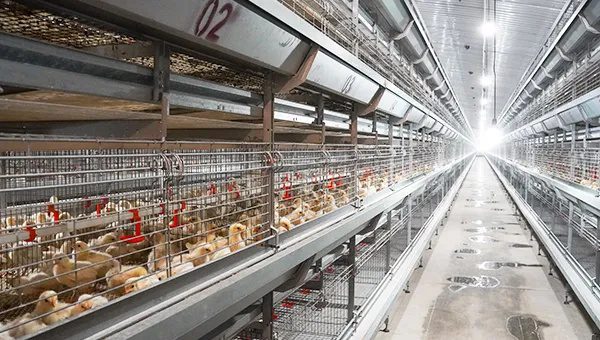
An automatic chicken feeder is a chain-driven or auger-driven line that pulls feed from a storage bin and drops it into feed pans (broilers) or a long trough (layers) at fixed points along the cage row.
The system has four parts:
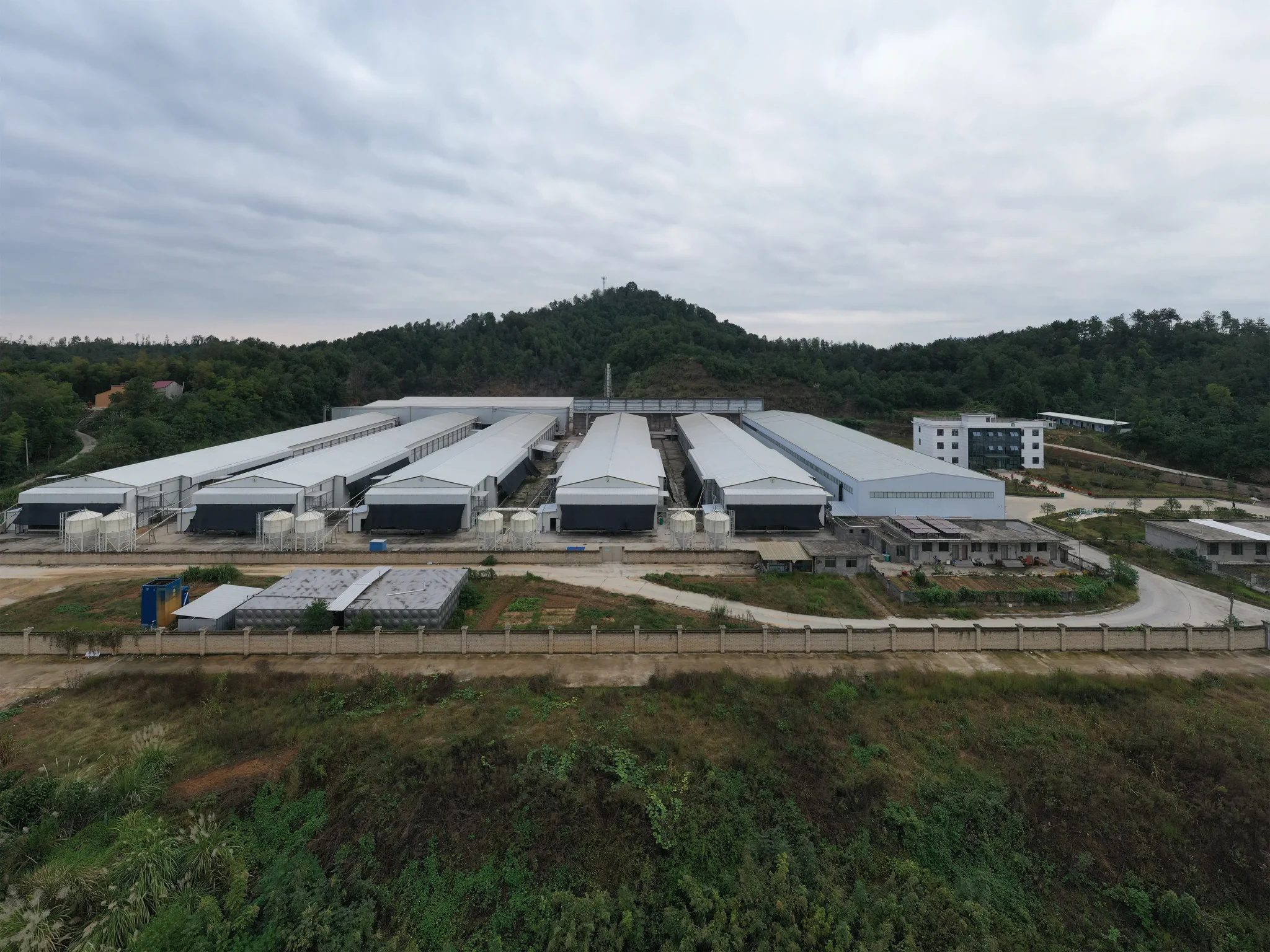
- Feed bin (silo). Stores the bulk feed delivered by truck. Sizes range from 1.6 t up to 33.4 t. Material options are hot-dip galvanized (HDG) steel, SS304 stainless, FRP, or aluminum alloy. HDG is the most common choice because it costs less and lasts 15+ years in dry conditions.
- Conveyor line. A 110 mm PVC pipe (for chain systems) or a 110–140 mm HDG tube (for auger systems) runs the length of the cage row. The chain or auger is driven by a 1.1 kW gear motor at one end.
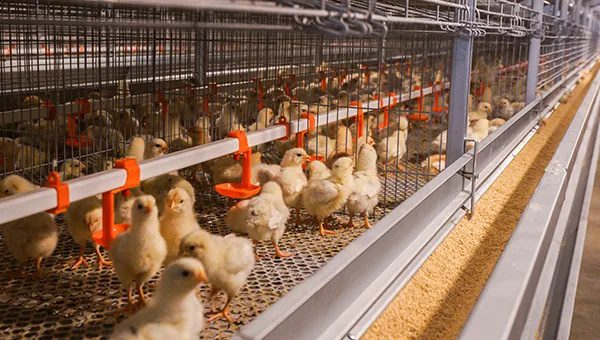
- Drop tubes and pans or troughs. Feed drops into a pan (broilers, 14–16 birds per pan) or a long trough with a grill (layers, with feed-saving edge).
- Control. A simple timer or a sensor at the end of the line tells the motor to run until feed reaches the last pan. More advanced setups add load cells on the bin and tie the system into the house controller.
The end result is the same on every farm: feed arrives at the same time, in the same amount, to every bird in the house.
How the System Runs Through a Day
A typical cycle on a 30,000-bird layer house starts at 05:30, when the operator hits the start button or the timer kicks in. The 1.1 kW motor pulls feed from the bin. By 05:35 the feed has reached the first drop tube and the line is now charged (a one-time cost). By 05:40 the feed is in every pan and the end-of-line sensor has stopped the motor. Second run at 13:00 is faster because the line is already primed. Final run at 17:00 fills the birds’ crops before lights-out.
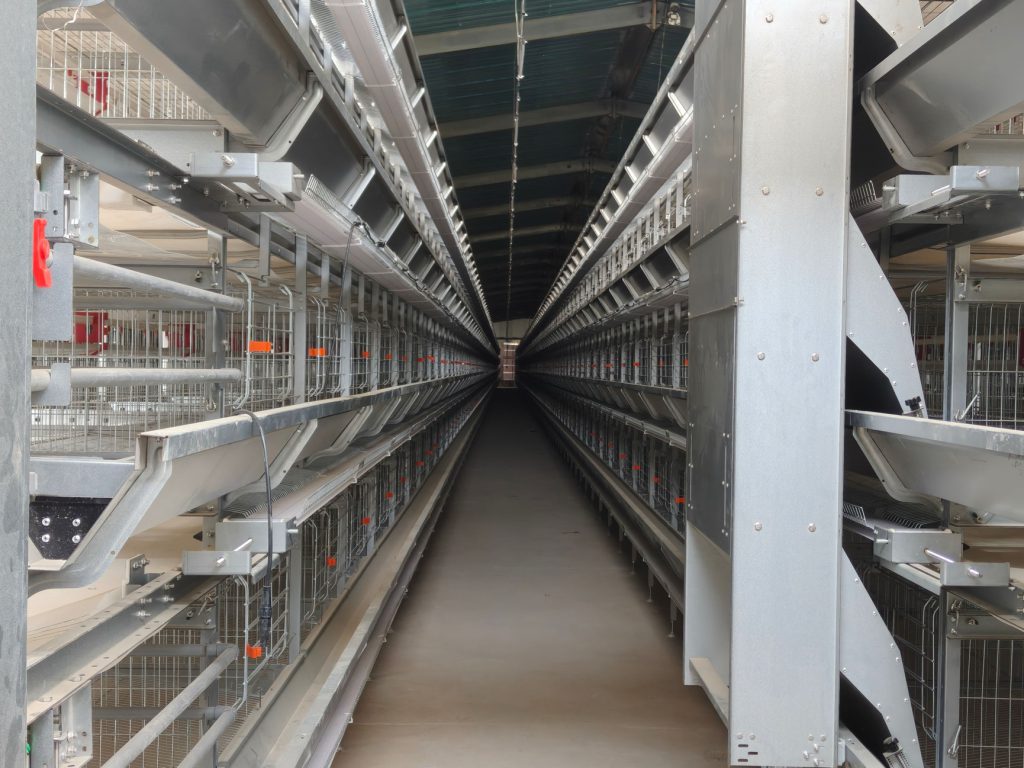
Total power draw is about 0.6 kWh per day for a 4-line house. The bigger cost is the feed itself, which is why a feeding system is judged on two things: does it put the right amount in the pan, and does it keep feed out of the manure.
Sizing the System to Your Flock
Three numbers drive the spec:
1. Bin size. You want at least 3 days of feed storage in the bin, so a truck delivery delay does not starve the flock.
| Flock size | Daily feed (layers) | Min bin size |
|---|---|---|
| 10,000 | 1.1 t | 4.3 t (model 1834-2) |
| 50,000 | 5.5 t | 21.3 t (model 3668-2) |
| 100,000 | 11 t | 33.4 t (model 3668-4) |
These are the bins we ship most often. The 3668 series at 33.4 t is the largest standard unit — beyond that you go to two bins side by side.
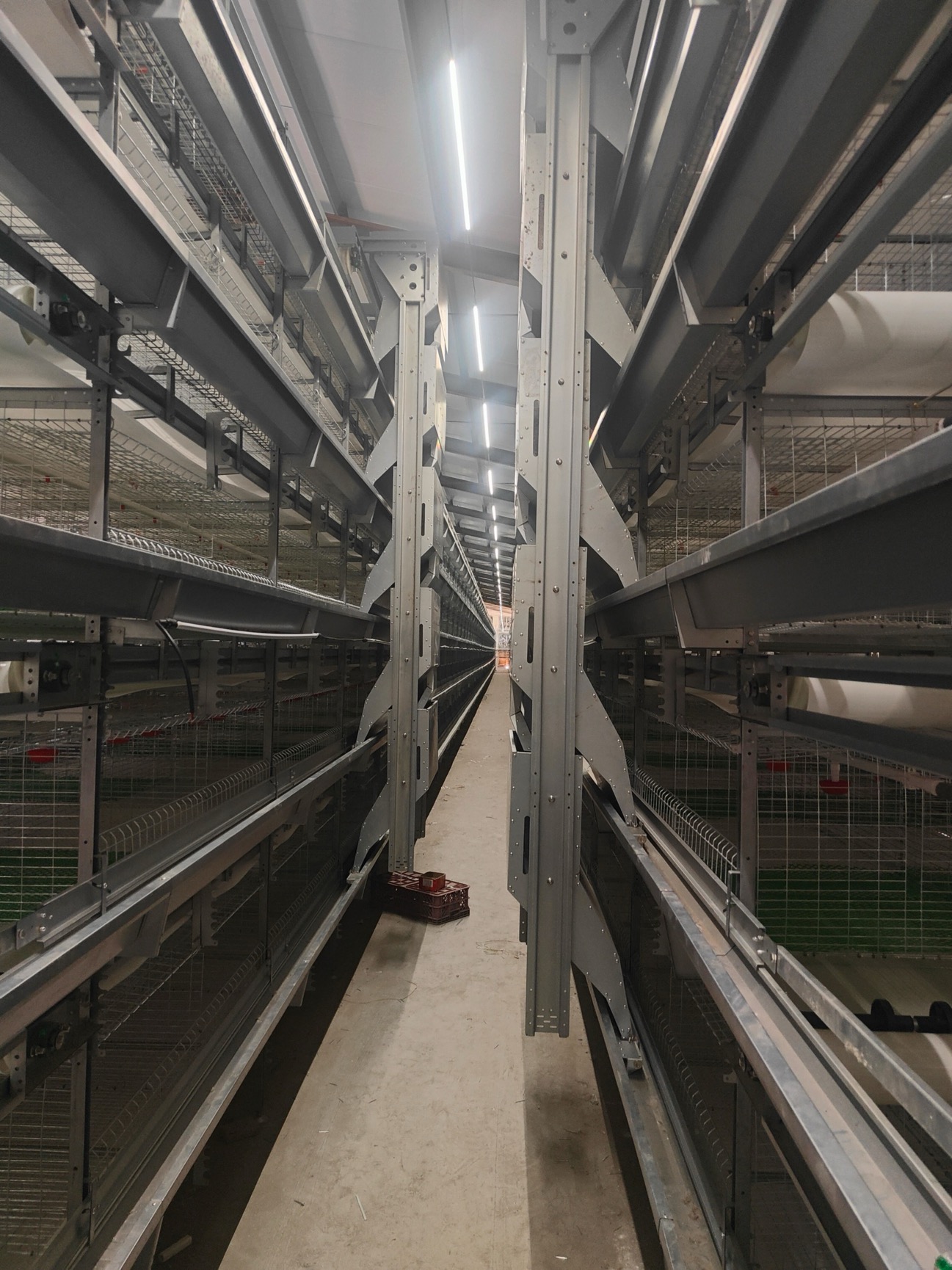
2. Line count and length. One line per cage row. For a 4-tier H-type layer cage, the line runs above the top tier, with drop tubes down to each tier. Line length is the row length plus 1–2 m for the drive unit and the corner.
3. Drive motor. 1.1 kW is standard for lines up to 180 m. Over that, you need a mid-line drive or a larger motor, otherwise feed arrives lumpy at the far end.
What Goes Wrong (And How to Avoid It)
These are the four failures we see most on service calls:
- Feed bridging in the bin. Fine feed or high-moisture feed can arch inside the bin and stop flowing. The fix is a vibrator on the bin cone, or switching to a steeper cone angle. We do not recommend relying on the auger to break a bridge — it stalls the motor and burns it out.
- Chain stretch. A chain that has run 3+ years will stretch, and the tensioner can only take out so much. You will see feed arriving late at the far end of the line. Replace the chain at year 4 in a 24/7 house.
- Pan adjustment. On broiler pans, the grill height is set for day-old chicks and raised as the birds grow. If it stays low, birds waste feed by scratching it out. If it goes up too early, smaller birds cannot reach.
- Water leak onto the feed line. A leaking nipple drinker above the feed line wets the feed, mold grows in the trough, and feed intake drops. Fix the drinker first; the feed problem is a symptom.
What Shifts When You Move from Manual to Automatic
The economic case for an automatic chicken feeder is built from three things, and the exact numbers depend on local labor cost, feed price, and flock size:
- Labor drops to a fraction of manual. Manual feeding on a 20,000-bird house takes two workers, multiple hours per day. Automatic feeding takes one operator a few minutes per cycle. Most of the feeding labor disappears.
- Feed waste drops. Manual trough filling scatters and soils a measurable share of feed. Pan and trough systems that meter the right amount into the right place cut that loss, which lowers the feed bill on the same flock at the same production level.
- Birds get feed on the same schedule. Uniformity of feed delivery translates into more uniform body weight and, on layers, a tighter laying curve. This is harder to put a number on but is the main reason large commercial farms moved to automation decades ago.
The economics favor automation on a 20,000-bird house in a country with mid-range labor cost. On small flocks in low-wage settings, manual feeding is often still the right call. For an actual payback figure, share flock size, target country, and feed cost with the YMAKO sales team.
Picking a Supplier
Three things to check before you order:
- Bin material and coating thickness. HDG coating should be 275 g/m² or higher. Anything below 120 g/m² will rust through in 4–5 years in a humid house.
- Motor brand. The 1.1 kW gear motor is the part that fails most. Stick with a name brand (SEW, Nord, or equivalent) — the saving on a no-name motor is not worth the downtime.
- After-sales. Ask how the supplier handles spare parts. The most common reason a feeding system sits idle for a week is a missing chain link or a drop tube, not a major failure.
To see how the feeding system fits into a full poultry house, look at our Poultry Control System page. For layer houses specifically, the feeding line runs above the Layer Cage System.
FAQ
How often should an automatic chicken feeder run?
Three to four times a day on a layer farm, timed for the hours after lights-on and before lights-off. Broilers run more frequently in the first week and taper as they grow.
Can a feeder handle mash, pellets, and crumbles?
Yes for pellets and crumbles. For fine mash, use a steeper bin cone and a vibrator, otherwise the feed bridges.
What is the power consumption of a feeder line?
A 1.1 kW motor running 15–20 minutes per cycle, 3–4 cycles per day, uses about 0.5–0.7 kWh per day per line.
Do I need a backup motor?
Keep one spare 1.1 kW gear motor on site. Swapping it takes 20 minutes. Waiting for a new motor to ship takes a week on most continents.
Q: What is the difference between an automatic feeder for chicken and a manual feeder?
A: An automatic feeder for chicken delivers feed on a programmable schedule without daily labor. Manual feeders require someone to fill and distribute feed by hand. For farms over 3,000 birds, the labor savings typically pay back the investment within one year.
Q: How does an automatic poultry feeding system improve feed efficiency?
A: An automatic poultry feeding system reduces feed waste by 5-8% compared to manual feeding, ensures consistent portions across all tiers, and allows precise schedule control. YMAKO systems support 2-4 programmable feed cycles per day with adjustable volume per cycle.
Conclusion
An automatic chicken feeder is not complicated, but the spec has to match the house. Get the bin size right, the line length right, and the motor brand right, and the system will run for a decade with nothing more than chain replacement and a daily walk-through. Get any of those wrong, and you will be the one carrying bags.
Related YMAKO Solutions: An automatic chicken feeder is typically deployed alongside a Y-type or H-type layer cage system for egg-laying operations, or an H-type broiler cage system for high-density meat bird houses. For pullet and quail operations, see pullet and quail cage systems. To automate the full barn, pair the feeder with a poultry climate control system and a poultry house design plan.
FAQ About Automatic Chicken Feeders
How much feed does an automatic chicken feeder save per day?
An automatic chicken feeder typically cuts feed waste from 8–15% (manual scattering) to 2–5% (controlled trough delivery). For a 10,000-bird broiler house consuming 14 tons of feed per cycle, that is 0.8–1.5 tons of feed saved per cycle — at USD 350–450/ton, USD 280–675 saved per cycle.
What is the difference between a chain feeder and an auger feeder?
A chain feeder uses a steel chain with paddles running through a trough — best for layers and mature broilers in long houses. An auger feeder uses a flexible or rigid spiral auger in a tube — best for pullets, broilers, and shorter houses. Chain feeders carry more feed per cycle and handle pellets cleanly; auger feeders are cheaper and easier to install but can grind crumbles.
How many birds can one automatic feeder line support?
For broilers: one chain feeder line supports 3,000–5,000 birds on a single loop, or up to 8,000 on a two-loop system. For layers: one chain feeder line supports 2,000–3,500 hens. Auger feeders typically support smaller groups (1,500–2,500 birds per line). For 10,000+ birds, you need multiple feeder lines running in parallel.
Can automatic chicken feeders work with both pellets and mash?
Yes, with caveats. Pellets flow easily through both chain and auger systems. Mash works in chain feeders but tends to bridge in auger tubes; if you feed mash, specify an auger with a larger diameter (75 mm+) and a feed agitator. Crumbles are intermediate — they work in chain feeders and in larger augers.
How long does an automatic chicken feeder last?
The trough and chain typically last 10–15 years. Drive motors last 7–10 years. The most common replacement parts are chain links, corner wheels, and feed-level sensors — these are 5–7 year wear items. Plan for 3–5% of capex as annual spare-parts budget.
Does YMAKO supply a complete automatic feeding system for both broilers and layers?
Yes. YMAKO supplies chain feeders, auger feeders, pan feeders, and the full set of hoppers, silos, drive motors, and feed-level controls. The same control logic works for broilers, layers, pullets, and breeders — only the feed curve and timing changes. See the chicken feeding system guide for the full system layout.