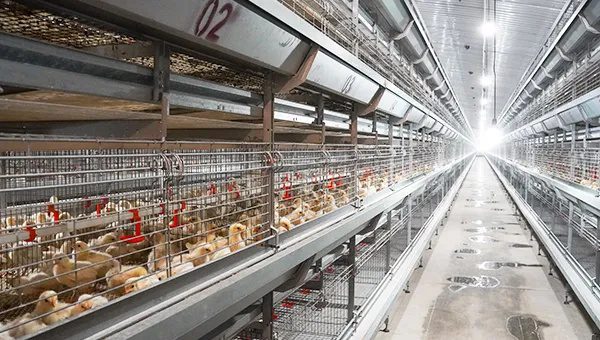
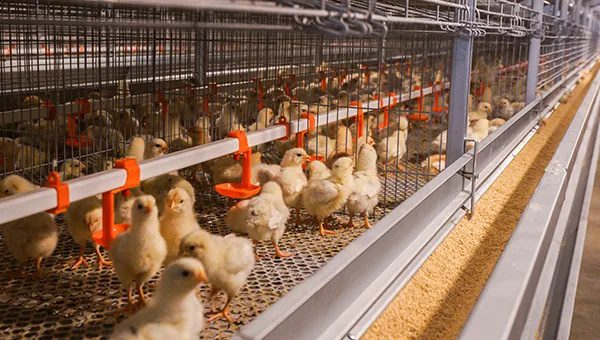
Picking the wrong broiler cage system is one of the most expensive mistakes a poultry farmer can make in year one. A house fitted with the wrong tier count wastes floor space, ventilation suffers, daily labor costs climb, and the birds simply do not grow at the rate the floor plan assumed. The two most common broiler cage types on the global market are A-Type (stair-step or A-frame) and H-Type (battery or stacked). They look similar in a brochure, but they are built for very different houses, climates, and budgets. This guide walks through how the two broiler cage types differ, where each one performs best, and three quick checks you can run against your own poultry house before you order.
A-Type vs H-Type: Side-by-Side Comparison
A-Type cages, sometimes called stair-step or A-frame cages, step upward like a staircase with the trough running along one side. They are usually 3 or 4 tiers high, and birds in each tier get good airflow because the trays do not stack directly on top of one another. H-Type cages, also called layer-battery or stacked cages, pack tiers vertically, which is why they are the dominant choice for tall, closed poultry houses. YMAKO’s broiler cage system catalog lists both styles with matching HDG frames and 275 g/m² hot-dip galvanized wire, so the comparison below is grounded in shipped product rather than catalog theory.
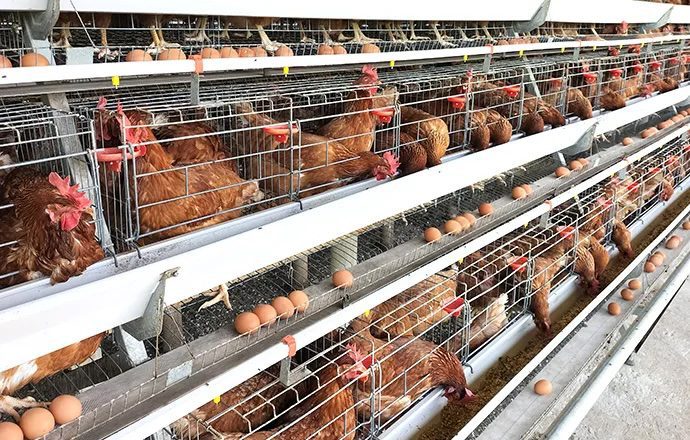
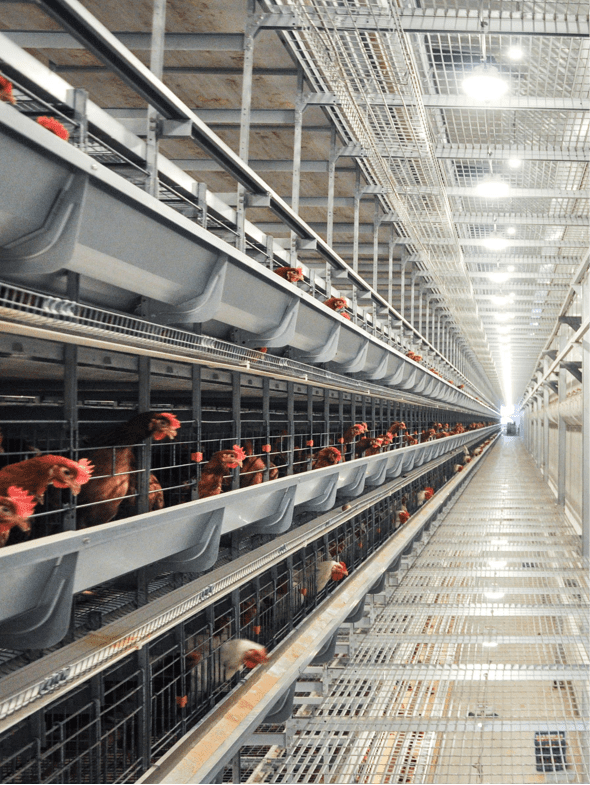
| Feature | A-Type (Stair-Step) | H-Type (Stacked) |
|---|---|---|
| Typical house height needed (eaves) | 3-tier ≥ 3.2 m, 4-tier ≥ 3.8 m (broiler rule of thumb) | 3-tier ≥ 3.3 m, 4-tier ≥ 4 m, 5-tier ≥ 4.6 m |
| Birds per set (YMAKO spec) | 15 birds (350 cage) or 20 birds (450 cage) per set | 32 birds (4-unit set) or 40 birds (8-unit set) per set |
| Airflow between tiers | Open sides, easier cross-ventilation | Tier-on-tier, depends on mechanical ventilation |
| Automation fit | Manual or semi-auto feeding | Fully automatic feeding, manure, and egg belts |
| Per-bird capex | Lower material cost, less automation built in | Higher material cost, higher bird density per m² |
| Best fit | Open or naturally ventilated houses, smaller flocks | Closed or climate-controlled houses, large flocks |
For most projects in tropical climates with open-sided housing, A-Type is the default. For high-density farms running 20,000 or more birds per house on tight land, H-Type pays back the extra structure through higher birds-per-square-meter and full belt-clean manure handling. The two broiler cage types are not competitors in the strict sense; they are tools for two different jobs.
Choosing the Right Cage Type for Your House
Before you finalize any quotation, run these three checks against your poultry house plan. They take about ten minutes and prevent the most common sizing mistakes our sales team sees on incoming broiler cage system enquiries.
Check 1: Is the House Open or Closed?
Open houses rely on natural ventilation through side curtains and ridge vents. In these buildings, air exchange is the limiting factor, not floor area. As a typical range in the industry, open houses perform best with 3-tier A-Type cages because the stepped design lets fresh air reach every tier without a fan. Closed houses, on the other hand, use tunnel ventilation, cooling pads, and negative pressure. They can support H-Type up to 8 tiers (YMAKO spec: 8-tier needs eaves ≥ 7.5 m). If your house has side curtains, do not assume you can scale to H-Type 5-tier later; the air simply will not move correctly, and summer mortality will tell you so before the first flock is finished.
Check 2: Eaves Height and Tier Spacing
Cage tier spacing is fixed by the manufacturer, so your eaves height dictates your maximum tier count. YMAKO’s broiler cage system specifies a minimum eaves height of 3.2 m for 3-tier and 3.8 m for 4-tier broiler cages. Layer cages need more room: 3.3 m, 4.0 m, 4.6 m, 5.5 m, and 7.5 m for 3- to 8-tier respectively. Measure the inner clear height of your poultry house, not the outer wall. A 10 cm mistake at this stage forces a redesign of the entire cage row and usually adds two weeks to the delivery schedule.
Check 3: House Width and Length
A useful rule of thumb in the poultry equipment business is to keep house width at 16 m or less, and length around 90 m, for the lowest cost per bird. YMAKO’s sales team typically declines projects where the house is shorter than 50 m because the per-bird capex jumps sharply once fixed costs are spread over fewer birds. Long, narrow houses also let cross-ventilation work as designed. If your site forces a 20 m × 40 m footprint, A-Type is usually a better fit than H-Type, because the lower tier count and open structure tolerate less-than-ideal ventilation, and the per-bird cost stays in a sensible range.
Why Choose YMAKO for Your Broiler Cage System
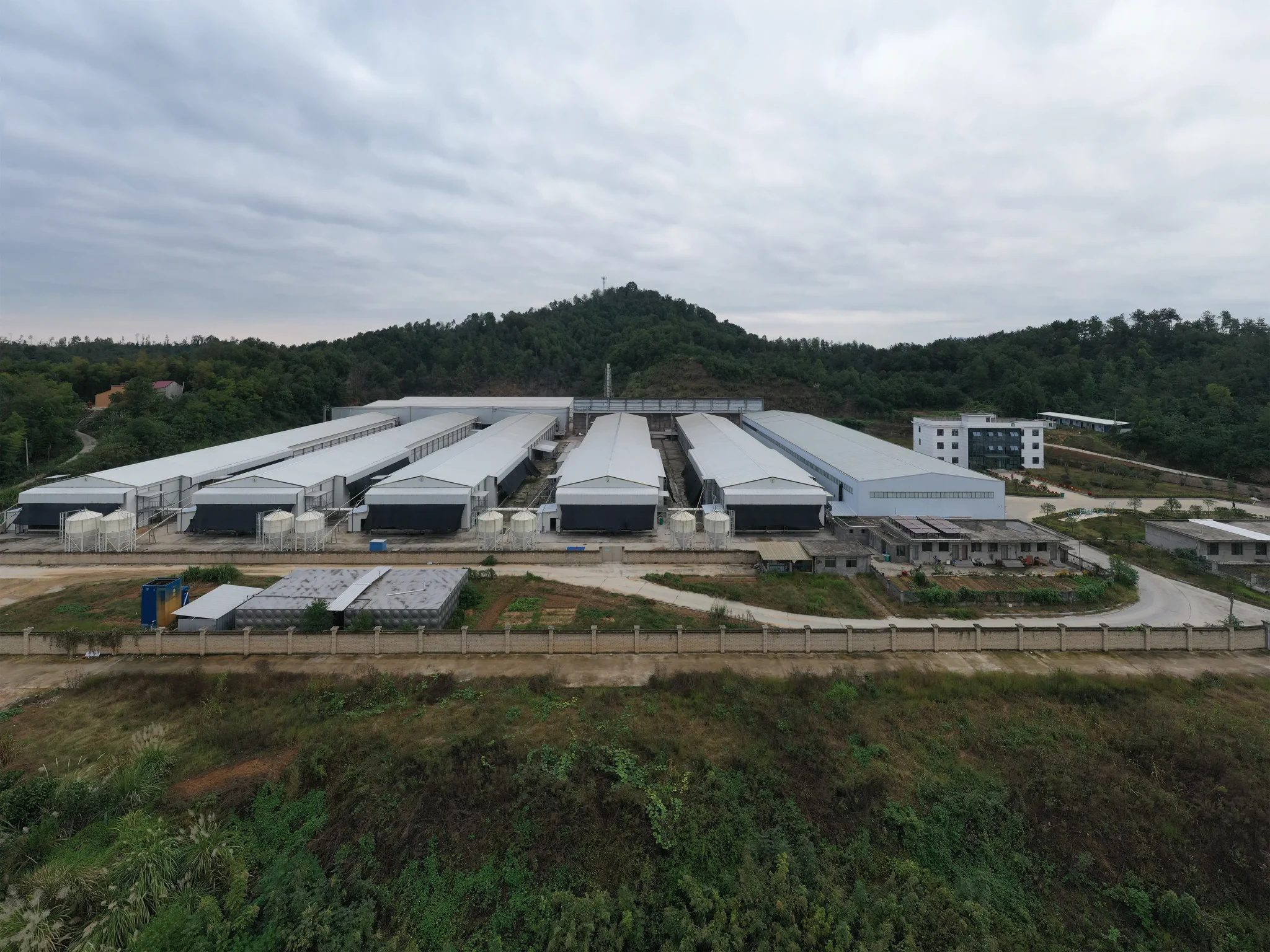
YMAKO supplies broiler cage systems and layer cage systems to 60+ countries from its Zhengzhou factory, with hot-dip galvanized frames, ZAM-coated wire, and 275 g/m² steel as standard. Every broiler cage system ships with SS304 nipple drinkers, a 1.5 kW gear-motor manure belt, and a PVC main water line. For farms that want full automation, the same line scales to PLC5.0, Siemens, or AC2000 environmental control, including 24-hour mobile monitoring and a 10-second auto-start for the backup generator. Explore the full broiler cage system lineup to match cage size, tier count, and control level to your house.
A YMAKO specialist can produce a free house layout drawing once you share your inner length, width, and eaves height. To get a quotation tailored to your climate, send those three numbers plus your target flock size to the YMAKO solutions team and you will usually receive a draft layout within two business days.
Frequently Asked Questions
What is the difference between A-Type and H-Type broiler cages?
A-Type (stair-step) cages are stepped, with each tier exposed to open air on one side, and are usually 3 or 4 tiers high. H-Type (stacked) cages are built vertically like a battery, with 3 to 8 tiers in the same footprint. A-Type suits open houses and smaller flocks; H-Type suits closed, climate-controlled houses and large flocks. Most farms choose between these two broiler cage types based on house style, not price alone.
How many birds can one H-Type cage set hold?
YMAKO H-Type cage sets hold 32 birds (4-unit, 1200 × 1250 × 690 mm), 40 birds (8-unit, 1800 × 1000 × 600 mm), or 25 to 30 broilers (open-inside, 1250 × 1000 × 600 mm). Total flock size scales linearly with the number of sets installed in the row, and the same frame accepts layer or broiler variants without modification.
What is the minimum eaves height for a 4-tier broiler cage?
Per YMAKO’s broiler specification, a 4-tier broiler cage needs an eaves height of at least 3.8 m. Layer cages at the same tier count need 4.0 m because the nest pads and egg belt add vertical space. Always measure inner clear height, and add at least 10 cm of working clearance above the top tier for the inspection vehicle.
Does YMAKO ship broiler cage systems worldwide, and is installation support included?
Yes. YMAKO exports to 60+ countries, with a typical lead time of 15 to 45 days after the 30% deposit. Every order includes an English installation manual, on-site supervisor scheduling, and remote video guidance. Spare parts ship within 72 hours to most destinations, and a complete spare-parts catalog is available before you place the order.