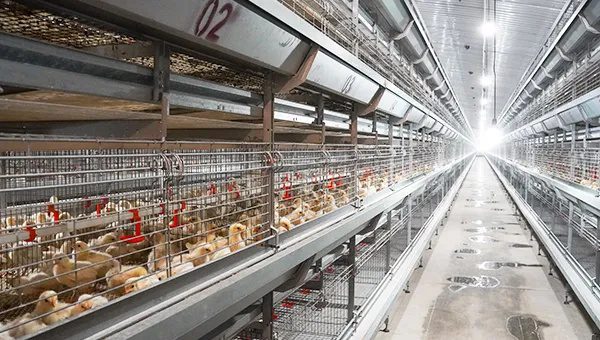
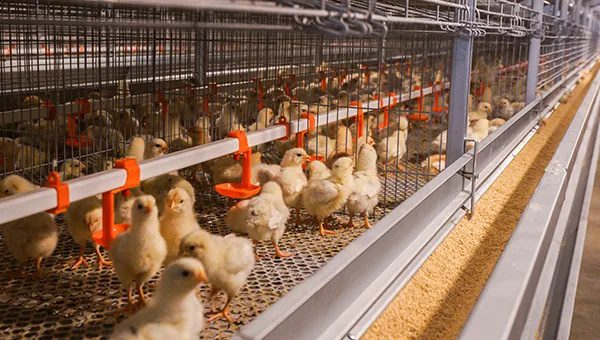
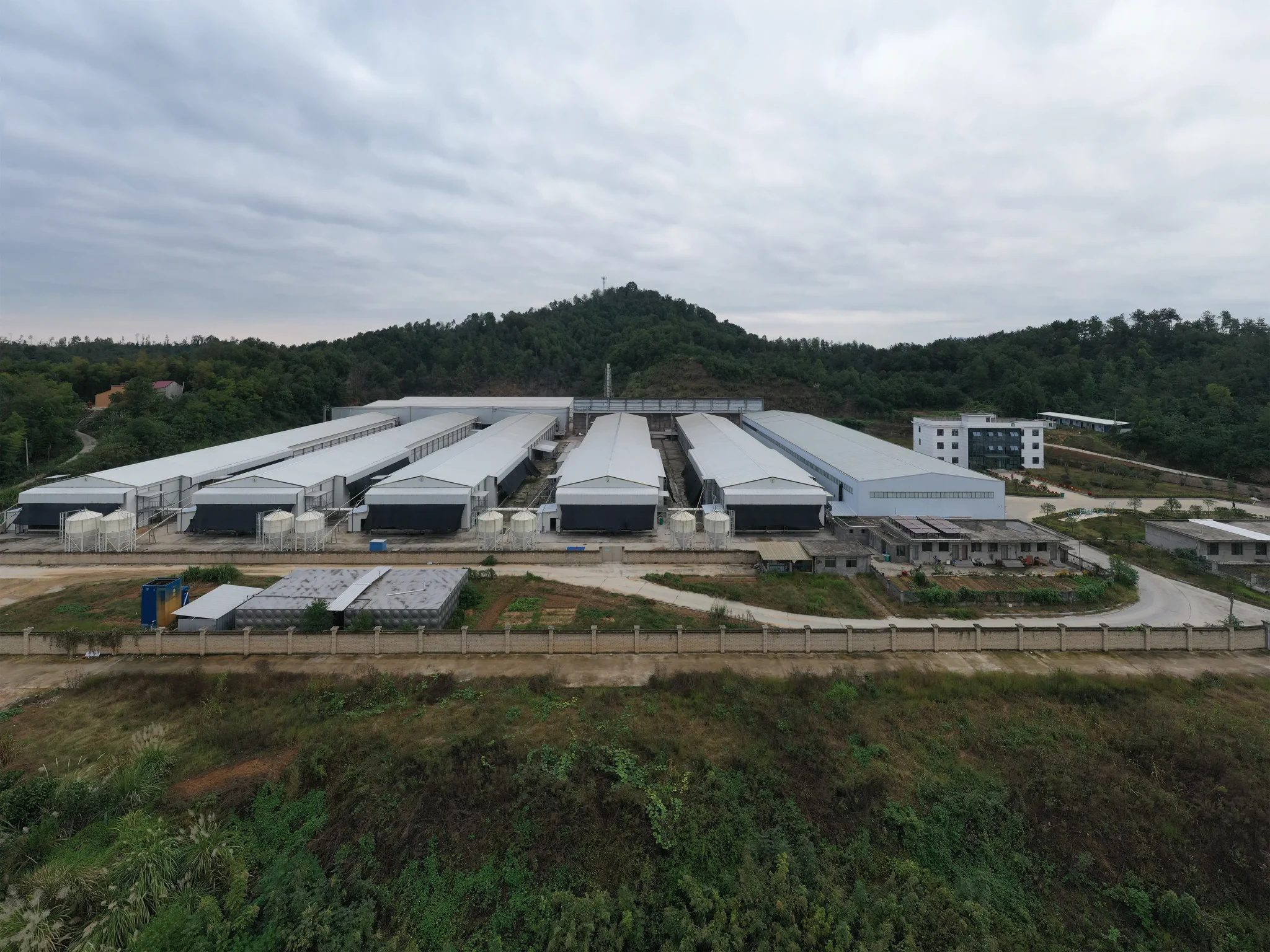
A chicken feeding system is the full set of equipment that moves feed from a storage silo or hopper, through a conveying line, and into the feeding station in front of each bird, on a fixed schedule, with no manual handling between bin and pan.
In a commercial layer or broiler house, the system is built from five parts working together: the feed bin, the conveyor (chain or auger), the drive motor and timer, the feeding line (trough, pan, or both), and the control unit that starts and stops the cycle.
The job of a chicken feeding system is not just to “deliver feed”. It is to deliver the right amount, at the right time, to every bird in the house, so that growth rate or lay rate stays even across the flock. A flock that gets feed at 05:30 one day and 09:00 the next will not finish a grow-out cycle on the same week. That is why almost every commercial poultry house above 5,000 birds runs an automatic chicken feeder.
YMAKO has built chicken feeding systems for layer houses from 5,000 to 200,000 birds across 60+ countries. The system you pick depends on the bird type (layer or broiler), the cage system (A-type, H-type, battery, or floor), and the climate (closed house, open-sided, or tropical).
What Is a Chicken Feeding System
A chicken feeding system is a chain-driven or auger-driven line that pulls feed from a storage bin and drops it into feed pans (broilers) or a long trough (layers) at fixed points along the cage row. The system runs on a timer or PLC, with an end-of-line sensor that stops the motor when feed reaches the last station. The result: feed arrives at the same time, in the same amount, to every bird in the house.
Main Components of a Modern Chicken Feeding System
Every chicken feeding system shares the same six core components. The size and capacity of each one changes with flock size.
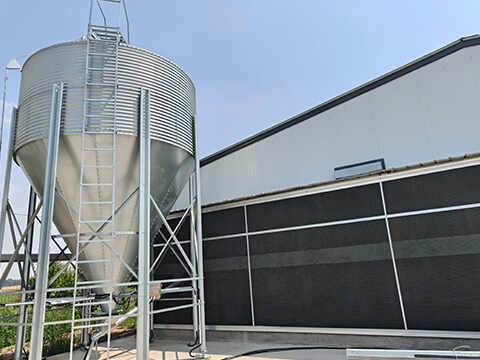
- Feed bin (silo). Galvanized or hot-dip galvanized steel, mounted outside the house on a stand. Standard sizes we ship: 2.75 t, 3.5 t, 4.6 t, 5.2 t, 6.8 t, 8.3 t, 10 t, 12.5 t, 15 t, 33.4 t. The 3668 series at 33.4 t is the largest standard unit. Beyond that you go to two bins side by side.
- Drive motor. 1.1 kW is the most common, sized for lines up to 150 m. A 30,000-bird layer house typically runs four lines off one 1.1 kW motor each, drawing 0.6 kWh per day total.
- Conveyor. Chain (for layer troughs) or auger (for broiler pans). Chain is heavier, lasts 8-12 years, handles mash feed. Auger is lighter, lasts 5-7 years, handles crumble and pellet.
- Feeding line. Trough (for layers, 2.5-3.0 m per section, 8-10 birds per section) or feed pan (for broilers, 14-16 birds per pan, 16-18 pans per line).
- Sensor and control — End-of-line sensor stops the motor when feed reaches the last station. Timer or PLC starts the cycle.
- Suspension winch — Manual or electric winch that lifts the entire line to bird-head height as the flock grows.
Chicken Feeding System for Layers (A-Type, H-Type, Battery)
Layer houses use a trough feeding line running the length of each cage row. The feed drops from the auger or chain into a long, narrow trough that runs in front of the cages, and birds reach through the cage front to eat.
- A-type layer cage: 4 birds per cage, 2 rows per unit, trough length 2.4 m per unit. Most common for 5,000-30,000 bird farms.
- H-type layer cage: 6-8 birds per cage, 4-8 tiers per unit, trough length 2.4 m per unit. Used for 30,000-200,000 bird farms because vertical density is higher.
- Battery layer cage: Small, modular units for backyard and starter farms (typically under 5,000 birds).
For layers, the chicken feeding system is judged on uniformity of feed distribution. Every bird in the house should reach the same weight at the same week, or peak lay will slip. A 1% drop in uniformity costs roughly 2-3 eggs per bird per cycle.
Chicken Feeding System for Broilers (Pan Feeding, Auger)
Broiler houses use feed pans suspended from a central auger line, not troughs. The reason: broilers grow from 45 g to 2.5 kg in 6 weeks, and the feed line must move with them. Pans adjust up and down on a winch.
- Standard pan: 14-16 birds per pan, 16-18 pans per line, 1 line serves 250-280 broilers.
- High-capacity pan: 16-18 birds per pan, for high-density broiler houses (18-20 birds/m²).
- Whole-house pan system: One auger loop per row of pens, common in 20,000-50,000 bird broiler houses.
For broilers, the chicken feeding system is judged on feed conversion ratio (FCR). A well-tuned system keeps FCR at 1.55-1.65 for a 6-week grow-out. A poorly adjusted system pushes FCR to 1.7+, which is the difference between profit and loss on feed alone.
How to Choose the Right Chicken Feeding System for Your Farm
Three things decide what you buy:
- Bird type — Layer = trough. Broiler = pan. Pick the wrong one and you either waste feed (pan in a layer house) or stunt birds (trough in a broiler house).
- Flock size — Under 5,000 birds: simple chain-and-trough, manual fill. 5,000-30,000: 1.1 kW motor, 1-2 feed bins, 4-6 lines. 30,000+: 1.5-2.2 kW motors, multiple bins, PLC control.
- Climate and house type — Closed house: PLC with climate integration. Open-sided: timer with manual override. Tropical: galvanized or stainless steel throughout, sealed motor housing.
A 30,000-bird layer house with an H-type cage system and a closed house climate setup is the most common starting point for a new commercial operation. The cost of a chicken feeding system for that size varies by configuration, country, and voltage requirements. Contact YMAKO with your project specifications for a personalized quote. For reference only, a typical system in this range falls between 8,000 and 15,000 USD ex-factory, depending on country of shipment. Final pricing is based on actual project configuration and customization requirements.
Chicken Feeding System Installation and Capacity Planning
Installation takes 3-5 days for a 30,000-bird house with a 4-person crew. The order is:
- Pour the bin stand foundation (concrete, 1.5 m × 1.5 m × 0.5 m, reinforced).
- Mount the bin and run the boot conveyor to the drive house.
- Hang the drive motor and transmission on the end wall.
- Run the chain or auger through the cage row, install the trough or pan suspension.
- Set end-of-line sensor and timer / PLC.
- Test cycle, then load feed.
Capacity planning rule of thumb: 1 line of 4-6 troughs per 1,000 layers. So a 30,000-bird house needs 30-60 troughs, which works out to 4-6 lines, each with a 1.1 kW motor.
Common Failures and Maintenance
The four most common failures on a chicken feeding system, in order of frequency:
- End-of-line sensor mis-calibration: motor never stops, feed piles up at the end. Fix: re-calibrate sensor, check for feed dust on the sensor eye.
- Chain stretch or auger wear: feed delivery slows, last stations underfed. Fix: tension chain (or replace at 8-12 years), replace auger flighting if it has worn below 80% of original diameter.
- Motor capacitor failure: motor hums but does not turn. Fix: replace capacitor (2 USD part, 5-minute job). Common at 4-5 years.
- Feed bridging in bin: feed sticks to bin walls, no flow. Fix: install vibrator on bin cone, or switch to a bin with steeper cone angle.
Preventive maintenance schedule: weekly visual inspection of line, monthly chain tension check, quarterly motor bearing check, annual full system audit.
Frequently Asked Questions
What is the difference between a chicken feeding system and an automatic chicken feeder?
The chicken feeding system is the full set of equipment (bin, conveyor, motor, line, control). The automatic chicken feeder is the end-of-line delivery part. In a layer house, the “feeder” is the trough. In a broiler house, it is the pan.
How many birds can one chicken feeding system line serve?
A standard 1.1 kW motor with chain or auger can run a line up to 150 m, which serves 4,000-6,000 layers (trough) or 4,500-5,500 broilers (pan). Larger flocks need multiple lines or larger motors.
What is the power consumption of a chicken feeding system?
A 4-line 30,000-bird layer house draws about 0.6 kWh per day for the feeding system, including 4 cycles of 15 minutes each. The bin loading and climate control are separate loads.
How much does a chicken feeding system cost?
Ex-factory pricing for a 30,000-bird layer system varies by motor size, bin count, and destination country. Contact YMAKO for a personalized quote tailored to your project. Ocean freight, installation, local voltage, climate, and cage-system integration all affect the final total. For reference only, a complete feeding system in this range typically falls between 8,000 and 15,000 USD ex-factory, with ocean freight adding 1,500-3,000 USD and installation 2,000-5,000 USD. Actual pricing is based on project configuration and customization requirements.
How long does a chicken feeding system last?
Chain-and-trough: 12-15 years. Auger-and-pan: 10-12 years. Motors: 8-10 years. Bin: 20+ years. The most-replaced parts are the chain or auger, the motor capacitor, and the end-of-line sensor.
—
For sizing help or a quote tailored to your flock size and country, contact the YMAKO sales team at info@ymako.com.