Choosing the right layer cage is the single biggest equipment decision you will make for a commercial egg farm. The wrong choice — wrong tier count, wrong cell size, wrong mesh, wrong feeding density — costs you yield and adds years to your payback. This article walks through the design decisions that determine whether your layer cage will deliver the production numbers it was sold on. We focus on practical selection: what to specify, what to ask the supplier, and what to test before you sign the purchase order. All cage specifications referenced are YMAKO’s standard production spec (Equipment Specification, 2026).
What Is a Layer Cage, Exactly?
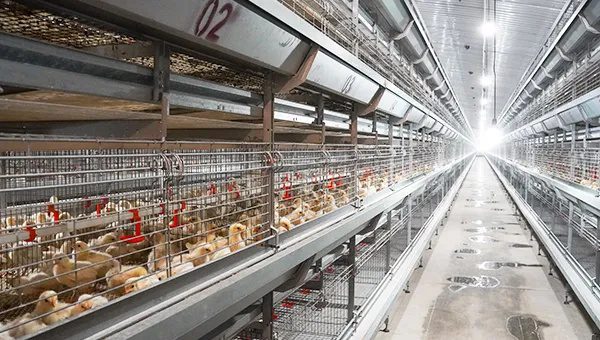
A layer cage is a galvanized wire enclosure that holds 3 to 8 laying hens in a controlled environment, with sloped flooring that rolls freshly laid eggs onto a collection belt. Layer cages are arranged in vertical tiers (3 to 8 levels) inside a poultry house, and the entire arrangement is called a layer cage system. The cage itself is the smallest unit; the system includes feeding, drinking, climate, manure removal, and egg collection.
If you are still at the planning stage, see our layer cage system ROI and setup guide for the full project-level economics. For a side-by-side comparison of the system-level design, see layer cage system: design, capacity, and economics.
The 4 Main Layer Cage Types
Layer cages are usually classified by geometry and tier count. Each type fits a different farm size, climate, and budget:
- A-type, 3-tier — stair-step (pyramid) shape, 3 tiers, walkable top deck. YMAKO standard group: 1950×350×470 mm, 15 birds per tier. Eave height ≥3.3 m. Best for 1,000–5,000-bird starter farms or pullet rearing.
- A-type, 4-tier — the most common commercial configuration. YMAKO standard group: 1950×450×500 mm, 20 birds per tier. Eave height ≥4.0 m. Best for 5,000–30,000 birds per house in mild climates.
- H-type, 4–6 tier — enclosed battery, walkable aisle between tiers. YMAKO standard H-type groups: 1200×1250×690 mm (4-group, 32 birds) and 1800×1000×600 mm (8-group, 40 birds). Eave height 4.6–5.5 m. Best for 30,000–100,000 birds per house.
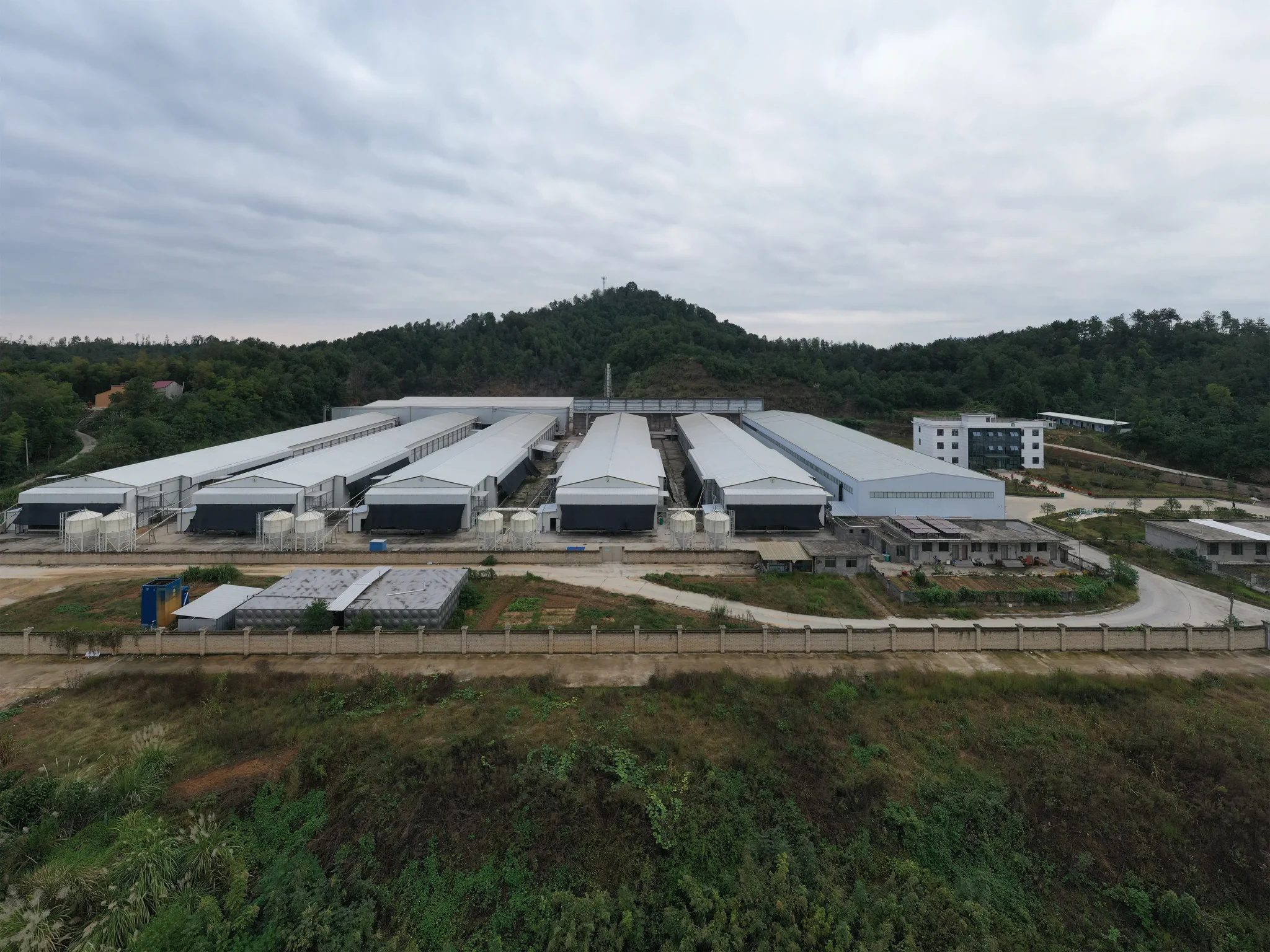
- H-type, 8-tier — highest density, fully enclosed. Eave height ≥7.5 m. Best for 100,000+ bird projects on expensive land. YMAKO’s 200,000-layer reference project (Southeast Asia, 2024) uses this configuration across 6 houses — see the 200,000-layer case study.
A-type cages are cheaper to install and easier to service. H-type cages are denser and more climate-efficient. For most mid-size farms, A-type 4-tier is the sweet spot; for projects over 50,000 birds per house, H-type pays for itself quickly through labor and land savings. For a broader market overview, the poultry equipment buyer’s guide walks through how to evaluate suppliers across cage, climate, and feeding categories.
What to Specify When Ordering a Layer Cage
Use this checklist when requesting a quote. If the supplier cannot answer in writing, that itself is a red flag. All numbers below are YMAKO’s standard spec:
- Zinc coating: 275 g/m² minimum, hot-dip galvanization. Lower coatings rust through in 5–7 years. YMAKO uses Shougang 275 g/m² HDG steel for cage frames.
- Wire and sheet thickness: Uprights ≥2.0 mm, crossbeams ≥1.2 mm, egg guard ≥0.8 mm, cage door wire ≥⌀5.0 mm. Cage floor bottom mesh typically ⌀3.0/2.5 mm.
- Cage cell size: 450 cm² per bird for white layers, 500–600 cm² for brown. Anything smaller triggers feather pecking. YMAKO’s standard layer density is 22 birds/m² of floor area.
- Floor slope: 7–10° toward the egg belt. Flatter slopes cause eggs to roll back and crack.
- Mesh opening: 25 × 25 mm bottom mesh to let manure drop through; smaller openings clog.
- Door design: push-to-open or slide, with positive locking. Birds that learn to open the door will escape and fight.
- Frame dimensions: YMAKO’s standard 3-tier A-type is 2.08 m total frame height, with the upper feed hopper at 2.4 m above floor and the lowest cage bottom 350–420 mm above the floor (leaving working access for the manure belt).
Feeding and Drinking Layouts
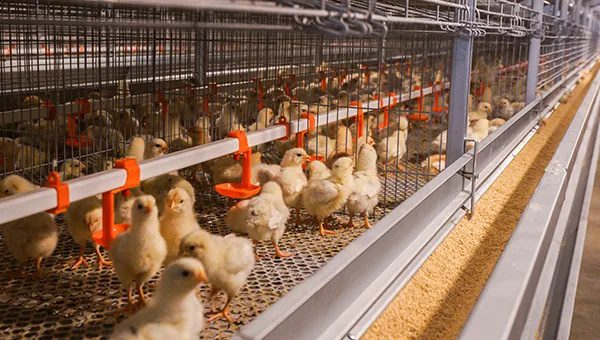
The cage’s feeding and drinking design is part of the cage itself, not a separate subsystem. YMAKO’s standard configuration:
- Feed trough: 8–10 cm wide, with anti-waste lip on the inside. The YMAKO chain feeding system runs at 6.5 m/min, sized to one full trough pass per feeding cycle, and cuts feed waste 25–35% versus manual scattering.
- Drinker position: nipple drinkers above the feed trough encourage simultaneous eating and drinking, which improves feed conversion. 1 nipple per 4–5 hens. YMAKO uses SS304 valve needles and triggers on the nipple drinkers, with ⌀25 mm main water line and 22×22 mm branch lines.
- Adjustment: drinker height must be adjustable as the flock grows. Fixed-height drinkers either waste water (too low) or restrict intake (too high).
Manure Removal: A Decoupled Decision
Manure handling is technically separate from the cage but is physically mounted to it. For modern layer cages:
- Manure belt under each tier — PP material, 1.0–1.2 mm thick, ≤220 m length, ≤2.0 m/s belt speed, 1.5 kW drive motor. See the automatic manure conveyor system page for design details.
- Cross conveyor at the end of the house, moving manure to a centralized collection or directly into an organic fertilizer system.
- Frequency: in-batch scraping 1–2 times daily keeps ammonia below the 20 ppm ceiling and supports respiratory health. Belt cleaning after every batch is standard.
Climate Control Around the Cage
The cage defines how air moves through the house. YMAKO’s climate control targets for layers:
- Optimum temperature: 18–25°C (acceptable 13–28°C).
- Maximum ventilation (laying hen, 2 kg): 7–9 m³/kg/h via 1380×1380 mm exhaust fans at 38,000 m³/h each, paired with 15 cm cooling pads (5–6 m² of pad per 50-inch-equivalent fan).
- Minimum ventilation (winter): 0.9–1.2 m³/kg/h.
- CO₂ ceiling: 2,500 ppm. NH₃ ceiling: 20 ppm. Target relative humidity: 60%.
- YMAKO PLC controller (AC2000 / Mitsubishi / Siemens) with temperature, humidity, CO₂, and NH₃ sensors, plus auto-start backup generator (10-second transfer).
For full climate layout, see poultry house design. For background on the engineering principles behind agricultural ventilation, the agricultural engineering entry on Wikipedia provides useful context.
Sourcing Checklist: How to Evaluate a Supplier
- Factory visit or live video walkthrough. Ask to see finished cages in stock, not just brochures. YMAKO operates 5 mesh-welding production lines and 6 cold-roll forming lines, with single-house capacity of 200 cage groups per day.
- Reference projects in your country or climate zone. YMAKO’s reference list includes 200,000-layer projects in Southeast Asia, multi-tier installations across China, and export projects in 60+ countries.
- Material certificates. Mill test certificates for the wire and the zinc coating (275 g/m² minimum).
- Installation crew. Will the supplier send a crew to your farm, or are you on your own with a YouTube video? YMAKO provides on-site installation supervision and remote video guidance, with an English installation manual.
- After-sales: spare parts availability and warranty terms. YMAKO ships spare parts within 72 hours to 60+ countries from standard inventory. The first 12 months are when 80% of failures happen.
FAQ
How many birds per layer cage cell?
3 to 4 white layers per cell, or 3 brown layers per cell. Smaller cells (2 birds) reduce feather pecking in larger hens but increase capex per bird. YMAKO’s standard per-bird footprint is 450 cm² for white layers.
What is the difference between a layer cage and a battery cage?
“Battery cage” is the older industry term for layer cages. Modern layer cages are technically “enriched colony cages” with more space, a nest area, and a perch. The Wikipedia entry on battery cages covers the history and regulatory landscape (EU Directive 1999/74/EC) that drove the shift to enriched designs. If a supplier is still using the term “battery cage,” ask whether they mean modern enriched or older compact cages.
Can a layer cage be used for pullets?
No, not in the first 6 weeks. Pullet cages have adjustable floor height and tighter mesh to keep chicks contained. YMAKO supplies separate pullet cage systems for 0–18 week rearing, with transfer to the layer cage at week 18.
How long does a layer cage last?
YMAKO’s cage frame is rated for 15+ years with 275 g/m² hot-dip galvanization (Shougang steel, ≥2.0 mm uprights). Feeding, drinking, and egg-belt subsystems typically need 5–7 year component replacement; PP manure belts are a per-batch wear item. Belt cleaning after every batch is standard.
Is a 4-tier A-type cage still the right choice for a 10,000-bird farm?
For most 5,000–20,000 bird farms, yes. A-type 4-tier is the lowest-risk, most serviceable choice and is supported by a deep ecosystem of parts and labor. H-type starts to make sense above 30,000 birds per house. YMAKO’s engineering team can size the right configuration for your flock and house dimensions.
What payment and delivery terms apply?
30% deposit to start production, 70% before shipment (TT transfer or letter of credit at sight). Delivery is 15–45 days from deposit, depending on order size and production schedule. Spare parts ship within 72 hours to 60+ countries from standard inventory.
Ready to specify a layer cage for your project? Send us your flock size, climate, and target egg output for a free cage layout and quote. For a step-by-step supplier-evaluation framework, the poultry equipment buyer’s guide is a good companion read.