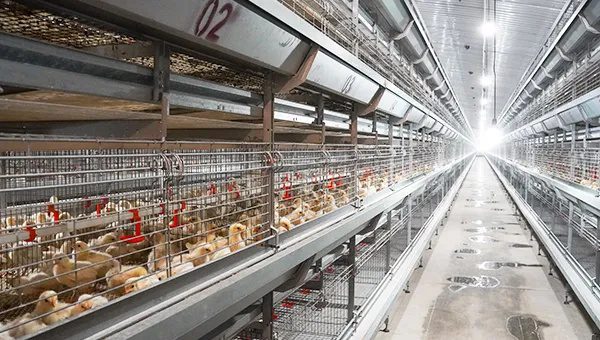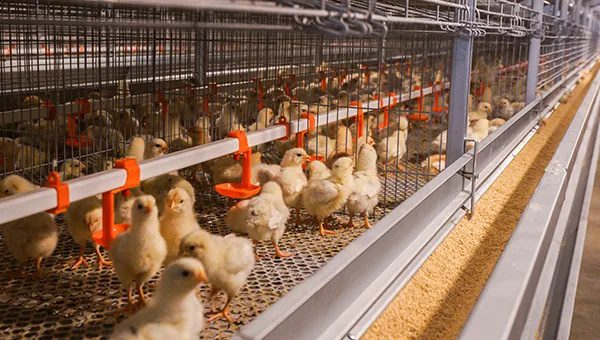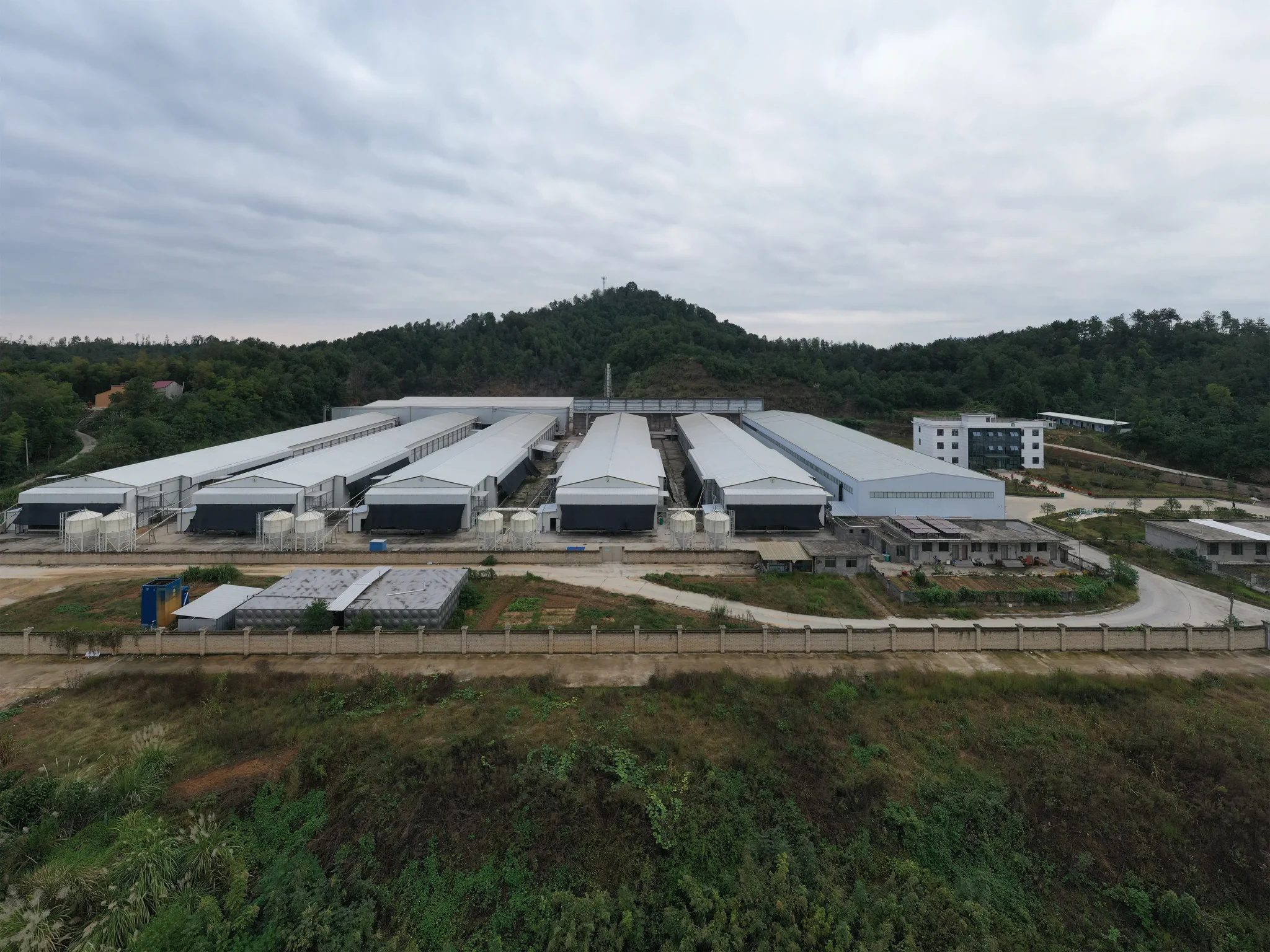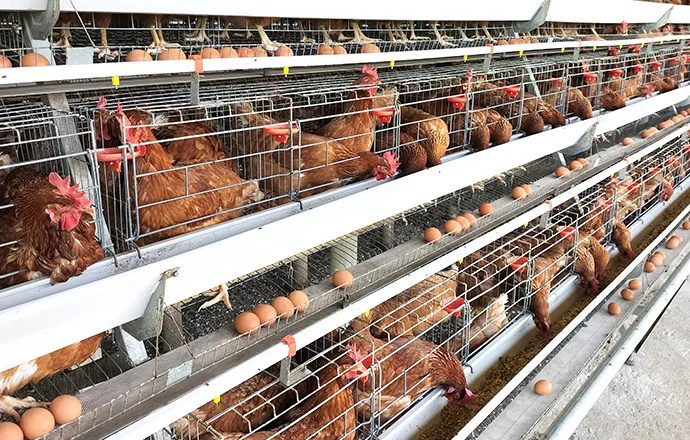
Broiler farming in cage systems has moved from a niche alternative to the mainstream of commercial meat chicken production over the past decade. Across Southeast Asia, the Middle East, Africa, and Latin America, the question for new projects is no longer whether to cage-raise broilers, but which cage geometry — A-Type or H-Type — fits the local climate, labor market, and target batch size. This guide walks through the design decisions, equipment specifications, and installation timeline that determine whether a broiler cage project delivers the production numbers it was sold on.
Why Broiler Cage Systems Are Replacing Floor Housing
Three structural forces are pushing commercial broiler operations toward cage systems:
- Land cost: A vertical H-Type cage stacks multiple tiers in the footprint of a single floor pen, cutting land use per bird materially versus floor housing. For projects on expensive peri-urban land, this alone can flip the project economics.
- Labor cost: A 20,000-bird floor house typically requires 6–8 workers for daily feeding, watering, and manure work. The same operation in a cage system with the YMAKO poultry control system and an automatic chicken feeder runs on a small core team focused on inspection rather than manual labor.
- Bird–manure separation: Cage systems separate birds from their own manure via the automatic manure conveyor, breaking the litter-disease cycle that drives antibiotic use on floor houses. The FAO poultry production manual discusses similar biosecurity benefits in industrial-scale operations.
YMAKO’s product range covers both A-Type (stair-step, 3–4 tiers, semi-open or naturally ventilated) and H-Type (stacked, fully enclosed with tunnel ventilation) cage geometries. Both use the same 275 g/m² hot-dip galvanized steel frame, the same nipple drinking system, and integrate with the same climate control platform. For a deeper look at the production advantages of automated systems, see how automated poultry cage systems are transforming modern farming.
H-Type vs A-Type Broiler Cage: Which Fits Your Farm
The two dominant cage geometries solve different problems. The decision is driven by house size, climate, and capital budget:
| Feature | H-Type (Fully Enclosed) | A-Type (Open-Top) |
|---|---|---|
| Tiers | Multi-tier stacked, fully enclosed house | 3–4 tiers stair-stepped, semi-open or naturally ventilated |
| Eave height requirement | ≥3.2 m (3-tier) / ≥3.8 m (4-tier) | Lower, open-top |
| Best climate | Hot / cold extremes, high-humidity regions | Mild climates (15–28°C year-round) |
| Ventilation | Tunnel ventilation, 1380×1380 mm fans @ 38,000 m³/h each, 15 cm cooling pads | Natural ventilation with side curtains or roof fans |
| Labor requirement | Lowest (full automation, small core team) | Medium (some manual feed top-up) |
For a side-by-side breakdown with floor plans and per-bird cost ranges, see our broiler cage types guide. As a rule of thumb, choose H-Type if your farm is above 20,000 birds per house, in a region with summer temperatures above 32°C, or where labor is expensive. Choose A-Type if you are below 10,000 birds per house, in a temperate climate, and have ready access to low-cost labor. For a wider market overview, the poultry equipment buyer’s guide walks through how to evaluate suppliers across cage, climate, and feeding categories.
Sizing Framework: Cage Density, House Dimensions, Ventilation
For a 1.6 kg target market weight on a 35–42 day grow-out cycle, use this framework to size cages, climate equipment, and feed storage. All numbers are based on YMAKO’s standard H-Type broiler cage specifications and the ventilation standards in our poultry house design guide.
- 5,000-bird house (entry): 1 H-Type battery, 4 tiers, 250 birds per tier section. Cage group 1250×1000×600 mm. House footprint 18 m × 8 m. One auger feeder line + nipple drinking line. Single 1380×1380 mm exhaust fan (38,000 m³/h).
- 10,000-bird house: 2 H-Type batteries, 4 tiers, 250 birds per section. House 30 m × 10 m. Two feeder lines + two drinking lines. Cooling pad + 2 fans. Daily water 3,000 L.
- 20,000-bird house: 4 H-Type batteries, 5 tiers. House 50 m × 12 m. Four feeder + four drinking lines. Tunnel ventilation with 6 fans + cooling pad. Daily water 6,000 L. Pair with a PLC climate controller (AC2000 / Mitsubishi / Siemens).
- 50,000-bird house: 8 H-Type batteries, 6–8 tiers. House 100 m × 15 m. Tunnel ventilation with 18–24 fans. Centralized feed silos with auger distribution. Backup generator essential (auto-start within 10 seconds of power loss).
For economy, YMAKO’s house design standard targets width ≤16 m and length ~90 m — configurations our engineering team has found to give the best per-bird installed cost. Houses shorter than 50 m typically see a sharp rise in per-bird cost and may not be economical to equip. For a real-world reference, see our South Africa broiler cage project or the Kyrgyzstan farm upgrade case study.
Equipment Checklist for a Complete Broiler Cage System
A working broiler cage system is a stack of 8 subsystems. Skipping any one of them creates a downstream bottleneck. All specifications below are YMAKO’s standard production spec (Equipment Specification, 2026):
- Cage frame and mesh: Hot-dip galvanized steel, 275 g/m² zinc coating. Uprights ≥2.0 mm, crossbeams ≥1.2 mm, egg guard ≥0.8 mm, cage door wire ≥⌀5.0 mm.
- Feeding system: Automatic chain or auger feeder with hopper, 1.1 kW reducer, feed-level sensor. Feed line 110 mm PVC or 110–140 mm HDG.
- Drinking system: ⌀50 mm PVC inlet, 22×22 mm or ⌀25 mm main line, SS304 valve needle and trigger nipple drinkers. Pressure regulator + dosing pump (French-made D25/D45).
- Manure removal: PP manure belt 1.0–1.2 mm thick under each tier, ≤220 m length, ≤2.0 m/s speed, 1.5 kW drive motor. Scraper runs 1–2 times daily.
- Climate control: PLC controller (AC2000 / Mitsubishi / Siemens), 1380×1380 mm exhaust fans @ 38,000 m³/h each, 15 cm cellulose cooling pads, brooder heaters.
- Lighting: 48 V 7 W LED dimmable 0–100%, IP-rated, 2-year warranty. 5 lux for the first week, 20 lux from week 2.
- Backup power: Diesel generator with ATS (auto-transfer switch, starts within 10 seconds of mains loss).
- Manure handling downstream: Optional organic fertilizer system (1–50 t/h capacity) to convert daily manure into pelletized fertilizer.
Ventilation Targets for Broiler Houses
Airflow is sized to body weight, not bird count. For broilers at market weight (around 2.5–3.0 kg), the YMAKO standard targets:
- Maximum ventilation: 7–9 m³/kg/h at peak summer
- Minimum ventilation: 0.9–1.2 m³/kg/h in winter
- CO₂ ceiling: 2,500 ppm
- NH₃ ceiling: 20 ppm
- Target relative humidity: 60%
- Inlet air speed: 3.55–3.8 m/s entering, slowing rapidly after entry
For a 35,000-bird house at 2 kg body weight in summer, peak airflow is 35,000 × 2 × 7.6 = 532,000 m³/h. With 38,000 m³/h per fan, that is approximately 14 fans running. Pair each 50-fan row with 5–6 m² of cooling pad. The general principles of agricultural ventilation provide useful background for engineers sizing these systems.
Day-to-Day Management in a Cage System
Cage broiler management differs from floor housing in three key ways:
- Bird density is fixed by the cage. You cannot thin the flock. All-in / all-out batches are mandatory to break disease cycles between cycles.
- Manure must be removed regularly via the manure belt. Cleaning the belt after every batch is standard; in-batch scraping 1–2 times daily keeps ammonia well below the 20 ppm ceiling and supports respiratory health.
- Feed and water access is uniform, which removes the variability that plagues floor operations. Feed-line speed on YMAKO’s chain feeder is 6.5 m/min — calibrated to one full trough pass per feeding cycle.
Installation Timeline
YMAKO’s standard installation cycle for layer and broiler cage projects is 23–26 days to first-bird placement, with final acceptance 27–30 days after that. Reference installations on the YMAKO record:
| Project | Type | Install (days) | First-bird (days) | Acceptance (days) |
|---|---|---|---|---|
| Handan 3-tier layer | Layer | 26 | 26 | 30 |
| Cheng’an 3-tier layer | Layer | 25 | 25 | 29 |
| Xiuyan 3-tier broiler | Broiler | 25 | 25 | 29 |
| Tai’an broiler retrofit | Broiler | 24 | 24 | 28 |
| Xingtai 3-tier broiler | Broiler | 23 | 23 | 27 |
| Baoding 4-tier pullet | Pullet | 23 | 23 | 27 |
| Nuanle 3-tier broiler | Broiler | 23 | 23 | 27 |
Add sea freight and customs clearance on top of this for export projects — typical end-to-end from purchase order to first-bird placement is 3–6 months depending on destination.
Common Mistakes to Avoid
- Skipping the backup generator. YMAKO’s control system auto-starts the generator within 10 seconds of mains loss; without it, a summer outage can be catastrophic in a fully stocked house.
- Undersizing the cooling pad. YMAKO’s rule of thumb: 5–6 m² of 15 cm cooling pad per 1380×1380 mm fan (50-inch equivalent).
- Buying cages without a manure plan. Manure accumulates continuously. Without a downstream handling route, you will have a waste problem in week 2. The poultry manure fertilizer system page shows how to close the loop.
- Mixing ages in one house. Cage systems require strict all-in / all-out. Mixed-age houses break the biosecurity advantage that justified the cage investment in the first place.
- House width over 16 m or length under 50 m. YMAKO’s engineering team flags these as cost-inefficient configurations. Width 13–16 m and length ~90 m is the standard.
FAQ
What is the standard H-Type broiler cage group size?
YMAKO’s standard H-Type broiler cage group is 1250×1000×600 mm, hot-dip galvanized, open configuration for broilers only. For details, see the broiler cage types guide.
How long does a complete broiler cage project take from order to first bird?
YMAKO’s standard cycle is 23–26 days installation to first-bird, 27–30 days to acceptance. For export projects, add sea freight and customs — typical end-to-end is 3–6 months from purchase order to first batch, depending on destination.
What is the minimum order quantity for YMAKO broiler cages?
A complete cage system for one house. YMAKO does supply mixed-container orders across cage types for smaller buyers; contact our sales team for a custom quote.
Do broiler cages cause breast blisters or leg problems?
Modern H-Type cages with plastic-coated bottom mesh bring breast blister rates well under 2% in commercial conditions. Leg quality is mostly a function of nutrition and stocking density, not cage type itself.
How is cage-raised broiler manure different from floor litter?
Cage manure has lower dry matter than floor litter, with a more consistent nutrient profile. It is a better feedstock for organic fertilizer pelletizing with less preprocessing, and the YMAKO cage system is designed to deliver manure directly to the fertilizer line via the cross conveyor.
What are the payment and delivery terms?
30% deposit to start production, 70% before shipment. Delivery is 15–45 days from deposit, depending on order size and current production schedule. Spare parts ship within 72 hours to 60+ countries from YMAKO’s standard inventory.
Ready to size a broiler cage system for your house? Send us your house dimensions, target bird count, and local climate for a free layout plan and equipment list. For a broader supplier-evaluation framework, see the poultry equipment buyer’s guide.